Square Appointments vs Acuity: the free desk that cannot charge anyone
Square’s $0 plan booked our salon’s clients faster than any tool we have tested, then could not take a deposit, charge a no-show, or record cash. Acuity is the first tool whose settings could express our policy sheet, and the first whose trial never emailed a client. Same salon, same week, both tested.
Some links below are affiliate links — if you subscribe through one, we earn a commission at no extra cost to you. It never changes a verdict; every tool runs the same test salon. Full disclosure
Square Appointments and Acuity Scheduling are the two tools a stylist hears about from outside the salon industry. One comes from the card reader on the counter; the other comes bundled with a website builder. Search square appointments vs acuity and you get Square’s page on Acuity, Squarespace’s page on Square, and roundups built from both pricing pages. Nobody on the first page has booked a haircut through either one.
So we did, from both sides of the desk. The salon is the same fictional one we have now run through GlossGenius and Vagaro and Fresha: Willow & Main, five providers including a booth renter and an esthetician, twelve services with add-ons, one membership, forty clients, and a scripted 34-appointment week with six traps planted in advance. Both tools got the identical configuration, the identical week, and the identical second identity booking, rescheduling, no-showing and paying from the client’s phone. The dataset and policy sheet are downloadable.
Square scored 15 out of 32. Acuity scored 19. And this time the margin is the useful number, because of where it comes from. On the twelve points that measure whether a tool can enforce the policy you show your clients, GlossGenius, Vagaro, Fresha and Acuity have all now scored seven. Square scored four. Four tools from four companies with four price models landed on the same number. Square is the first to fall below it, and it fell for a reason that is written on its own pricing page: the plan we tested costs nothing, and nothing is what it can charge.
The verdict, up front
Buy Square Appointments on the Free plan if you want a booking page your clients will finish in under three minutes, every price and every processing rate published on one screen, and a $0 subscription that genuinely covered all five of our providers. Understand that it is an appointment book. It cannot take a deposit, hold a card, charge a no-show, or record a cash payment, and it will not tell you when it has stopped sending reminders. Enforcing anything costs $49 a month plus a merchant account, and we did not test that plan.
Buy Acuity if you want the desk that can describe your policy. It is the first tool of five whose settings could express our two-tier deposit rule to the decimal, its booth-renter permissions are the best we have seen, and its intake forms and client records are a match for Fresha’s. Understand that the settings will not save without a payment processor, that its trial sends no email to any client and says so only inside the emails it sends you instead, and that its desk throttled us after seven appointments.
Neither tool charged a dollar of our policy. Read on for the two very different ways they did not.
How we tested (and what we couldn’t)
Square opened on 14 September on the Free plan and stayed there. We had planned to move to the $49 Plus trial for the trap week, because Plus is where Square puts its cancellation policy and no-show fees. We dropped that plan on day five, when the payment-policy screen showed that every deposit, prepayment and card-hold option on Plus also needs card processing switched on. Processing means merchant activation, which means a government ID and a selfie for a salon that does not exist. We do not cross that line for any tool, so Square was scored on Free, to the wall, with no card ever entered and no clock ever running.
Acuity opened on 19 September on the seven-day Standard trial, no card required, and closed on the 26th. Its wall is the same one by another name: Acuity processes nothing itself and connects to Stripe, Square or PayPal, none of which we connected.
Two things happened during the trials that limit what we can say, and both are findings in their own right. Nine days into Square, after one evening of normal desk entry, Square froze the account’s outbound messaging pending identity verification, and it never came back. We think our own test data tripped it, and we say so below. And Acuity’s trial, it turned out, never sends a client an email at all. Every confirmation, reminder and receipt arrived in the salon’s inbox instead, headed preview. Both tools’ reminder scores carry those caveats.
Every screen described here has a dated, numbered screenshot in our published score files.
Square vs Acuity pricing: the honest page and the missing rate
Square’s pricing page is the best we have read in five trials, and that is worth saying before anything else.
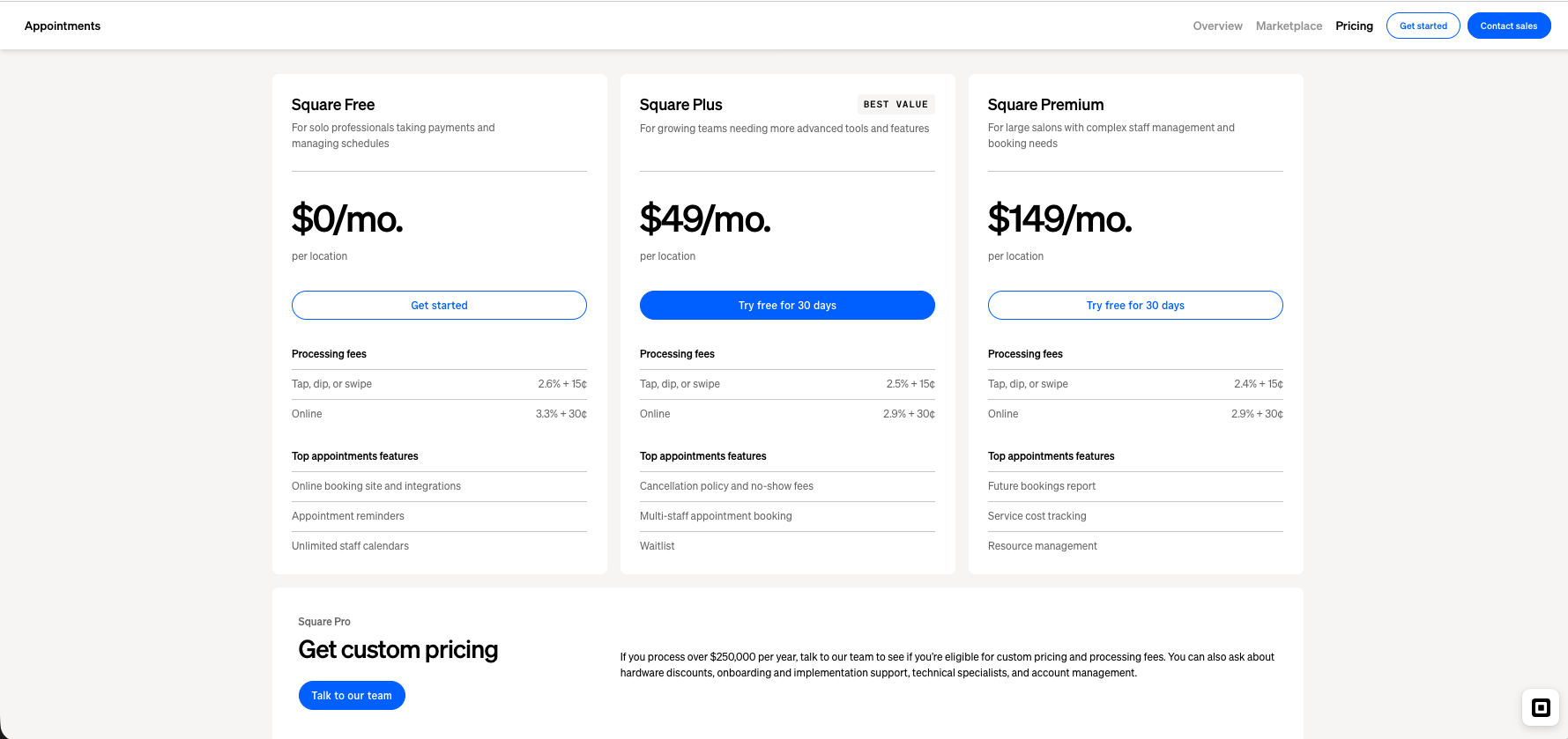
Free is $0 per location with 2.6% plus 15¢ in person and 3.3% plus 30¢ online. Plus is $49 with 2.5% and 2.9%. Premium is $149 with 2.4% and 2.9%. Per location, not per provider: our five-provider salon sat on six bookable calendars for exactly nothing, which is the roster Vagaro bills at $80 a month and Fresha at $74.75. The only pressure toward paid is a best value badge on Plus. Nothing is buried.
Acuity’s page is honest too, and per calendar in three steps: Starter $20 for one calendar, Standard $34 for up to six, Premium $61 for up to 36, each a few dollars less billed annually. Our salon plus a bookable owner fits Standard’s six exactly. What the page does not have is a processing rate, because Acuity has no processing. Every tier says payments via Stripe, Square, PayPal, Venmo, and the rate is whatever the processor you connect charges. The in-app payments screen recommends Stripe, so that is what we modelled: 2.9% plus 30¢ online, and because Acuity has no card reader, a desk payment is a card typed into Stripe’s form at its manual-entry surcharge, 3.4% plus 30¢. That last assumption is ours, from Stripe’s page, not from a transaction we ran.
Here is what the two cost over a year for the three salon shapes our calculator uses, subscription plus processing, from each vendor’s own pages as read on 28 September. Square is priced on Plus, because it is the cheapest Square plan that has a cancellation policy at all.
| Square (Plus, $49) | Acuity (Stripe) | |
|---|---|---|
| Solo booth renter · 85 appts at $65 | $2,566 | $2,668 (Starter, $20) |
| Three-chair salon · 260 at $78 | $7,789 | $9,071 (Standard, $34) |
| Six-chair salon + spa · 520 at $92 | $17,492 | $20,364 (Standard, $34) |
Square wins every row, and the reason is the desk. Its reader takes a card at 2.5%; Acuity’s desk types it at 3.4%. At the six-chair volume that half a point is more than $2,800 a year, which is why a $34 subscription loses to a $49 one. Bill Acuity annually and the gaps narrow by a few hundred dollars; they do not close. If you would run Acuity with a Square reader, which Acuity allows, the arithmetic changes and the calculator will let you change it.
But the row that matters for this review is not in the table. Square Free is $0, and it is a real plan that held our five providers for the whole trial. The question is what $0 buys, and the answer is in the settings.
Two walls
Our policy sheet asks every tool the same thing: clients book online, a card is required to book, services over $100 take a 20% deposit, a no-show is charged 50% less the deposit, a reschedule inside 24 hours is charged 25%. Four tools before these two could not express the two-tier deposit at all. Square and Acuity failed it in opposite directions.
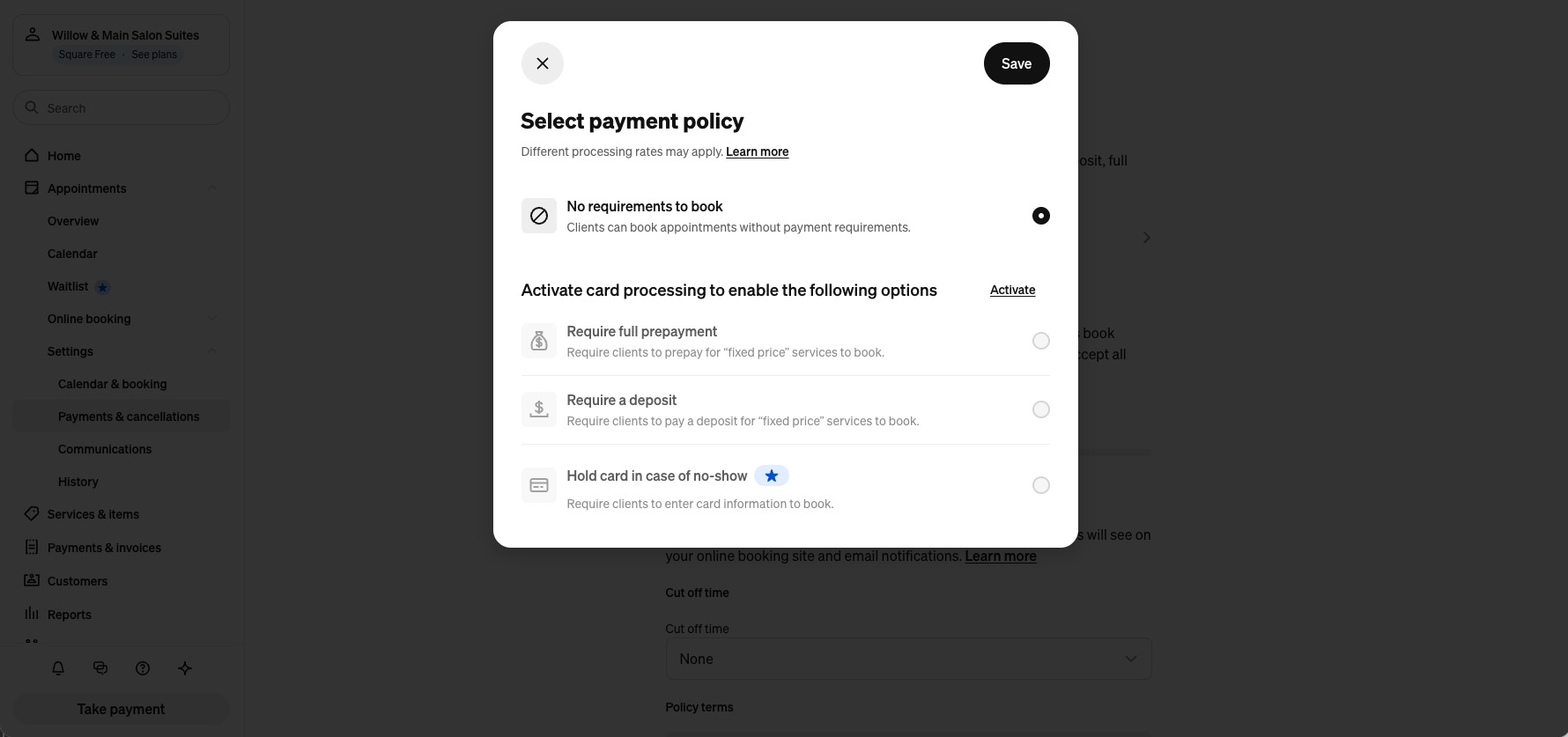
Square tells you on the way in. Three of the four policy options are greyed, grouped under a header that says Activate card processing to enable the following options, and the card-hold option also carries a Plus badge. It is the clearest wall disclosure of five tools, and it gets Willow & Main no closer to a deposit. The cheapest route to a card-on-file no-show fee on Square is $49 a month plus a merchant account, and the Free plan has no cancellation policy, no deposit and no fee of any kind.
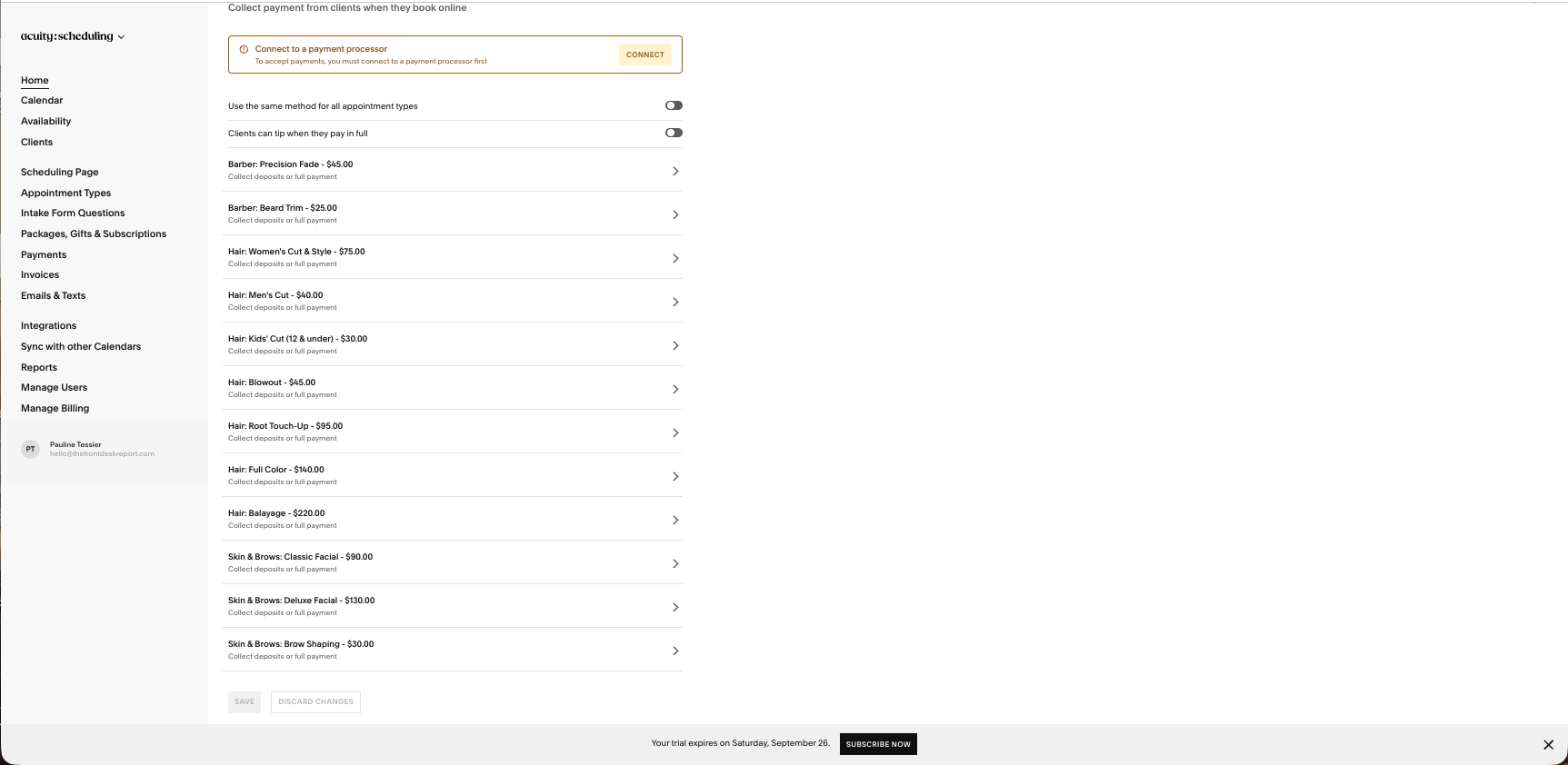
Acuity is the first tool whose fields can hold our policy. Switch off use the same method for all appointment types and every one of the twelve services gets its own rule, with Deposit amount (%) in the dropdown. We set 20% on the three services over $100 and card-on-file on the other nine, which is the policy sheet verbatim. Then the Save button never enabled, and a page reload reverted all twelve rows to the default. Nothing on the page said why. The amber banner above the form talks about accepting payments, not configuring them. Acuity’s help centre confirms the per-type deposit works once a processor is connected, and we cite that as documented, not tested. On a trial, the form is a description of a policy with no way to commit it.
Square has a second wall, and this one is quieter.
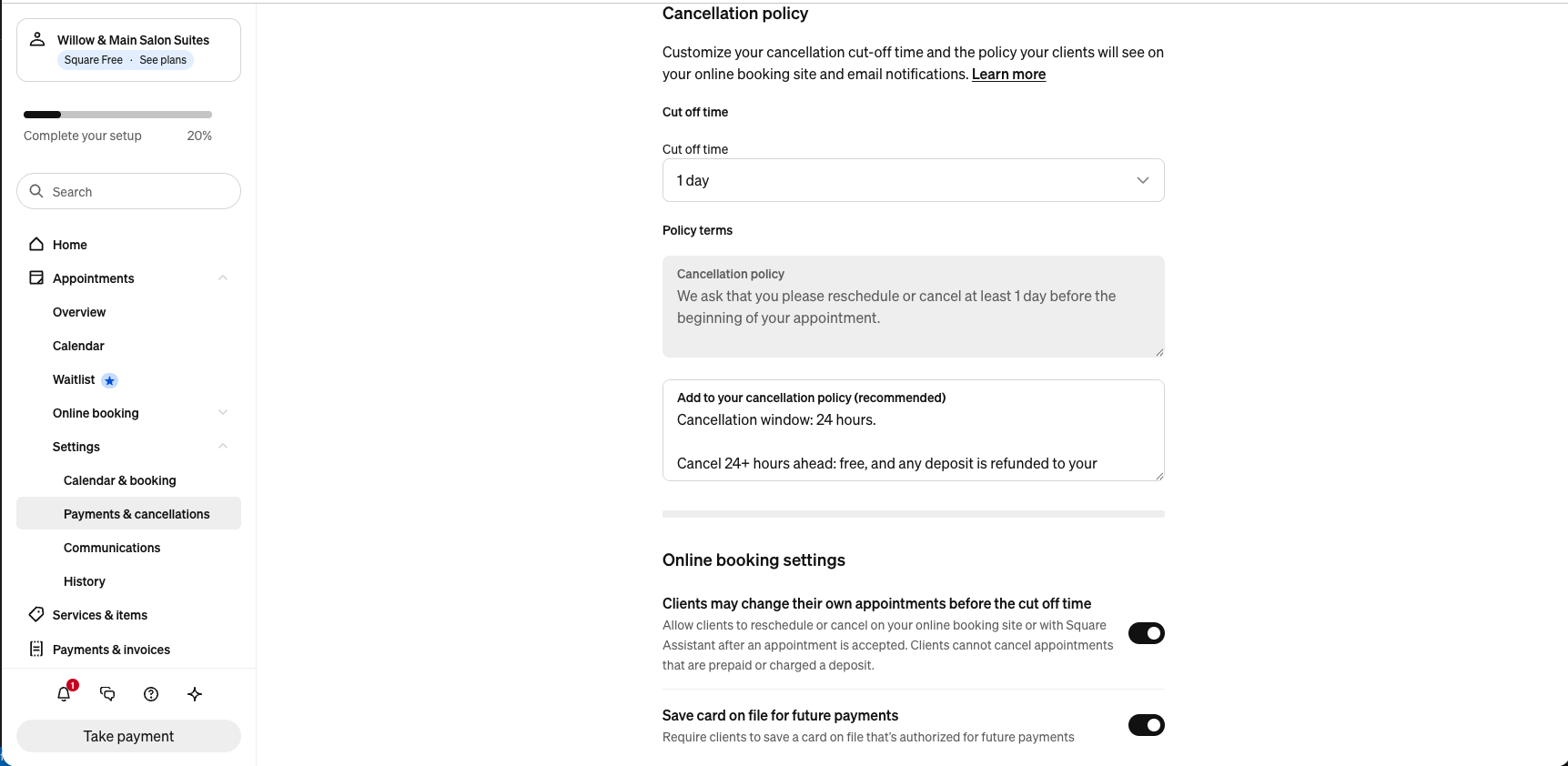
Require clients to save a card on file accepts the setting, shows it as on, and does nothing. Every client record read no cards on file throughout. GlossGenius did the inverse in August, enforcing a card it could not charge. Square enforces nothing and reports that it is enforcing. A salon owner who checked this screen would believe the policy was live.
Booking, from the client’s phone
If the desk cannot say no, the booking page at least says yes quickly, and both tools are good at this in different ways.
Square’s page took our client two and a half minutes from the link to thanks for booking. No account to create, no verification code, no password, and a fictional 555 number accepted without a text. Add-ons show per service, marked optional with their extra minutes. The suite number survives to the client. And it has the best policy disclosure we have seen anywhere.
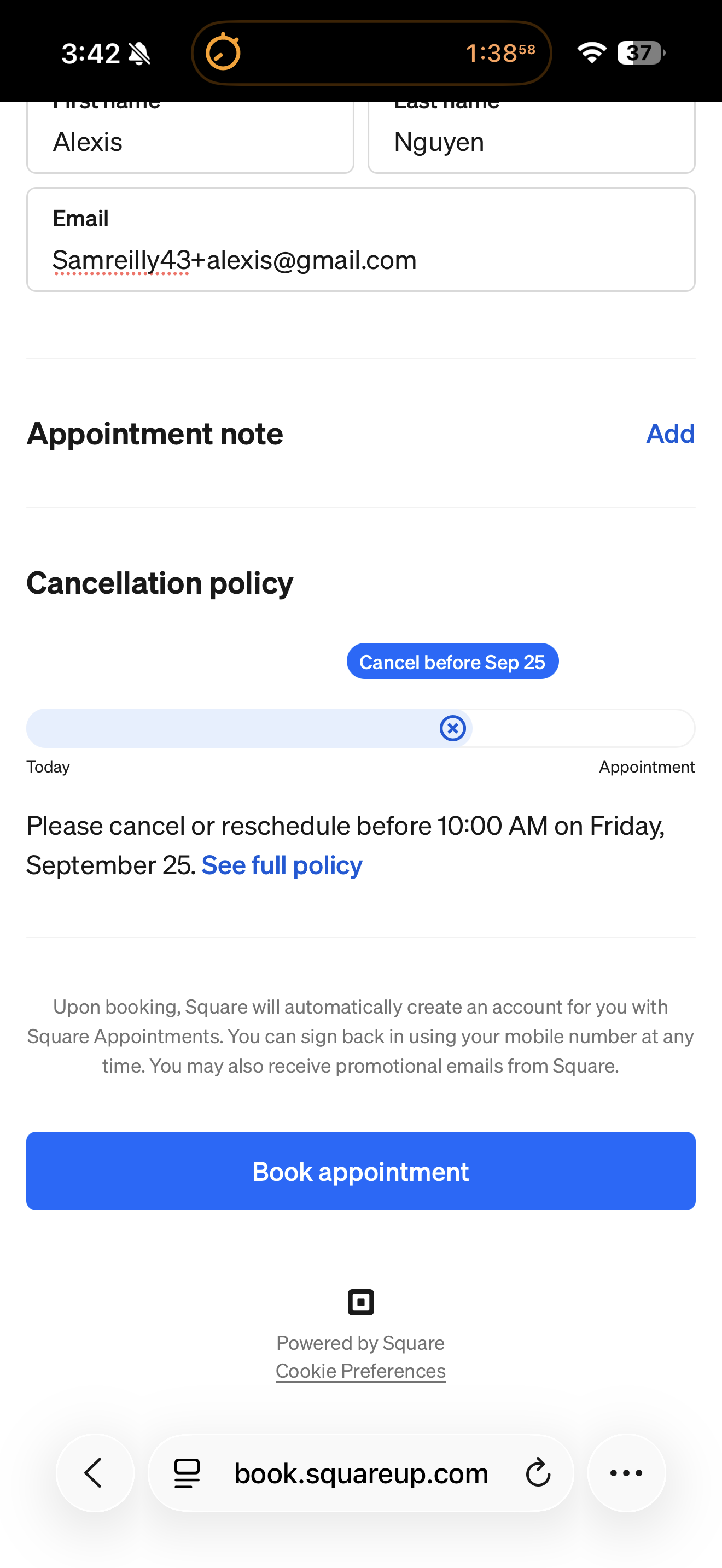
That fine print is the cost of the speed. Upon booking, Square will automatically create an account for you with Square Appointments. You may also receive promotional emails from Square. No box to untick. Booking a haircut is consent to a Square consumer account. It is lighter than Fresha’s mandatory signup and less honest than Acuity’s, which is a plain guest booking: name and email starred, phone optional, and we booked with it blank. Acuity’s took about two minutes, the lightest data demand of five tools, and its confirmation screen carries reschedule, cancel and add-to-calendar links with no login.
Two smaller things. Square’s booking page has no field for a promo code, so our new-guest discount could only be applied at the desk; Acuity’s has one, and it computed the discount exactly. And Square’s free booking address is an opaque string on Square’s own domain with no salon name in it anywhere; a branded address means adopting Square Online, a separate product with its own pricing. Acuity’s is at least Acuity’s, with the salon’s name on the page.
The traps
The six traps are where the policy sheet meets the software. Here is what each tool did with them, in the order they hurt.
The no-show. Our client booked a $220 balayage online and did not turn up. The policy says 50% less the deposit, $66 to the card on file. Neither tool has a deposit, a card, or a fee to compute, so both scored zero; the dialogs are worth seeing anyway.
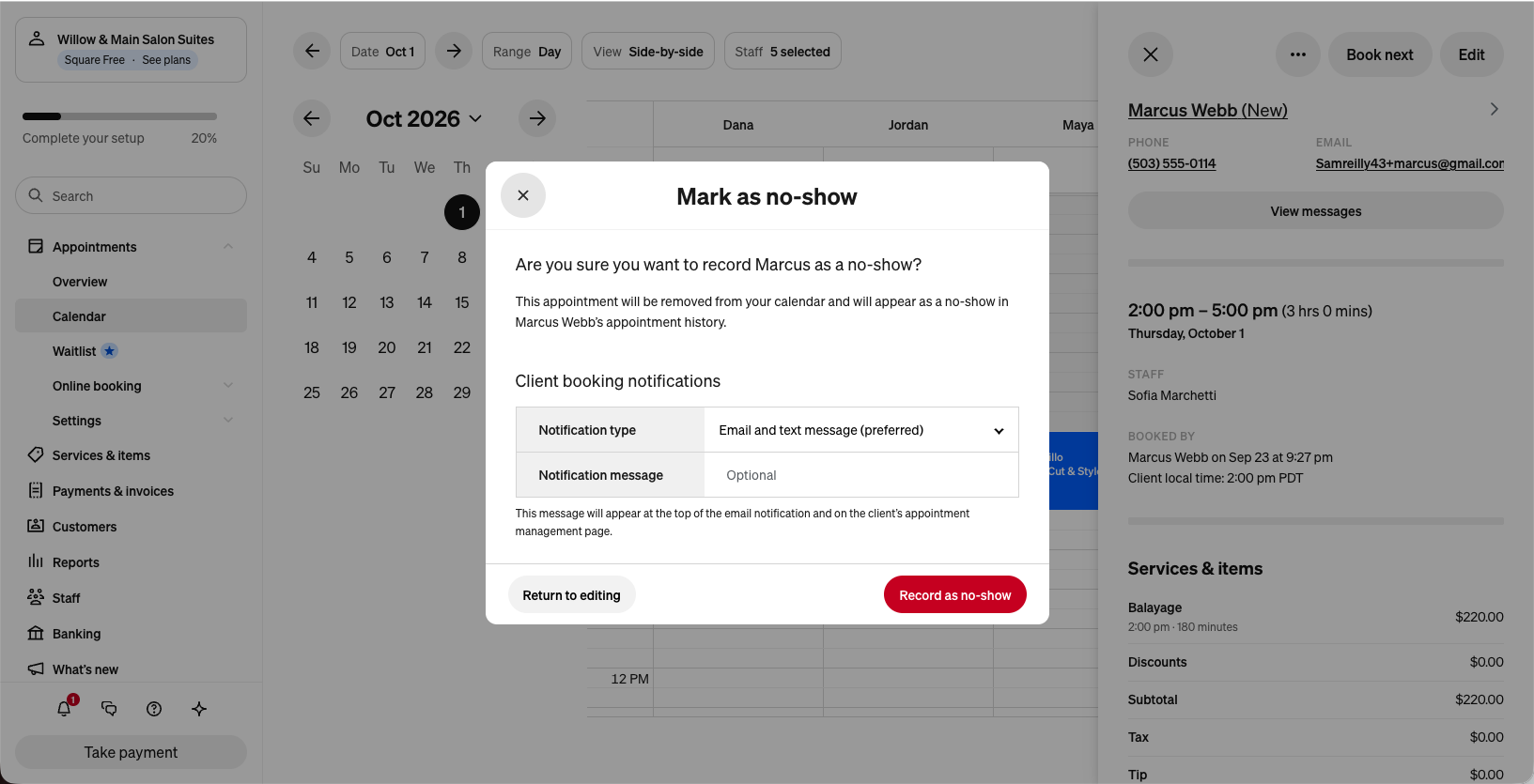
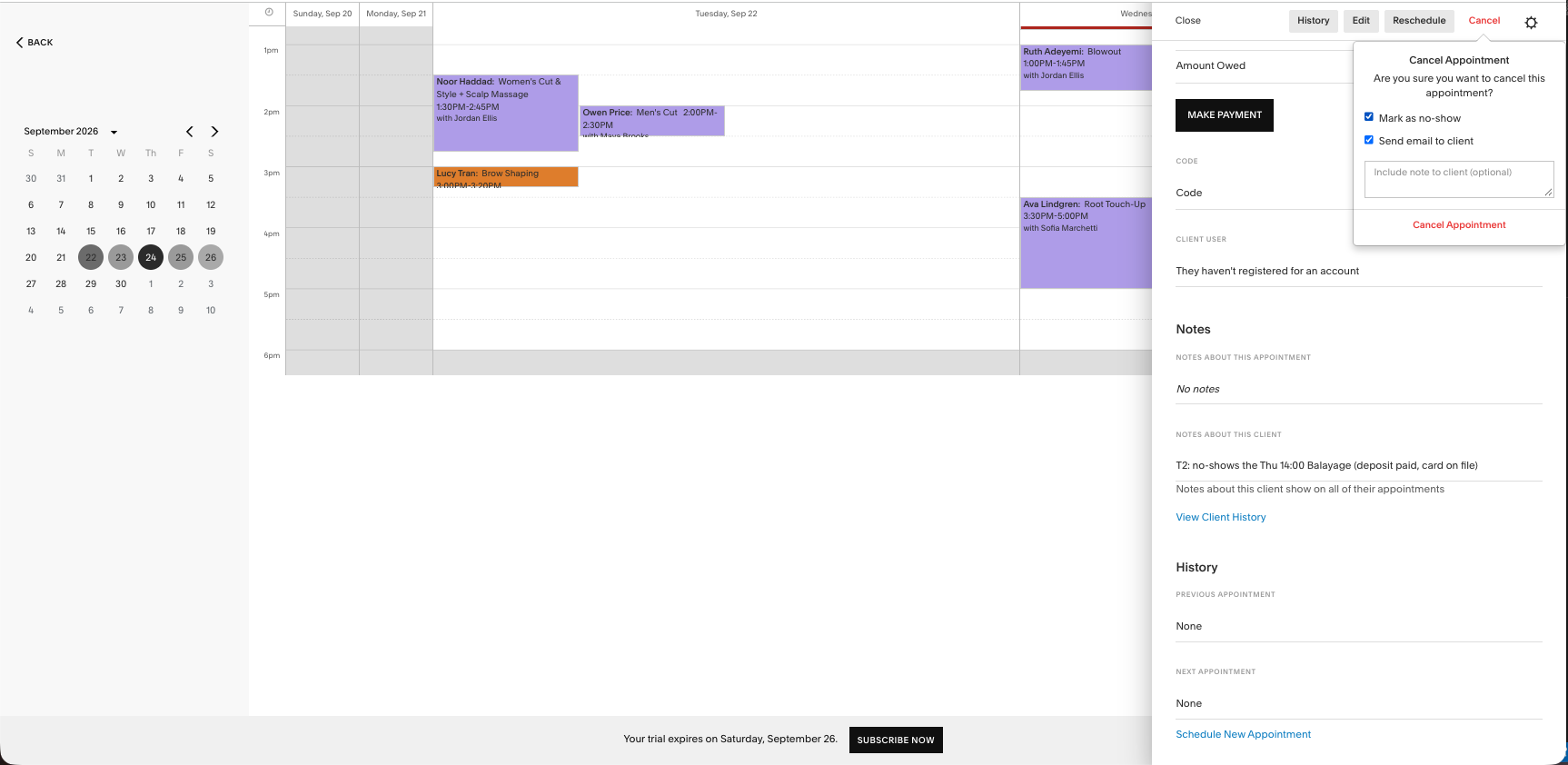
Square’s dialog says what will happen in plain words: the appointment will be removed from your calendar and appear as a no-show in the client’s history. That is accurate. The stylist’s 2 to 5 PM went blank, with no ghost block and no marker, and the client’s record gained a No show tag with Payment on file: Add beneath it. The no-show action is also time-gated, appearing only once the appointment has started, which is sensible. Acuity treats a no-show as a flag on a cancellation: tick the box, and the appointment leaves the calendar exactly as a cancellation does, the audit log records Appointment Cancelled, and only the client’s record, behind a show canceled appointments checkbox, says no show. Acuity’s help centre says a fee can be charged by hand afterwards against a saved card. There was no saved card. There never is, on either trial.
The late reschedule. A client with a 9 AM appointment asks to move it, the day before. Policy says that is a late cancel at 25%.
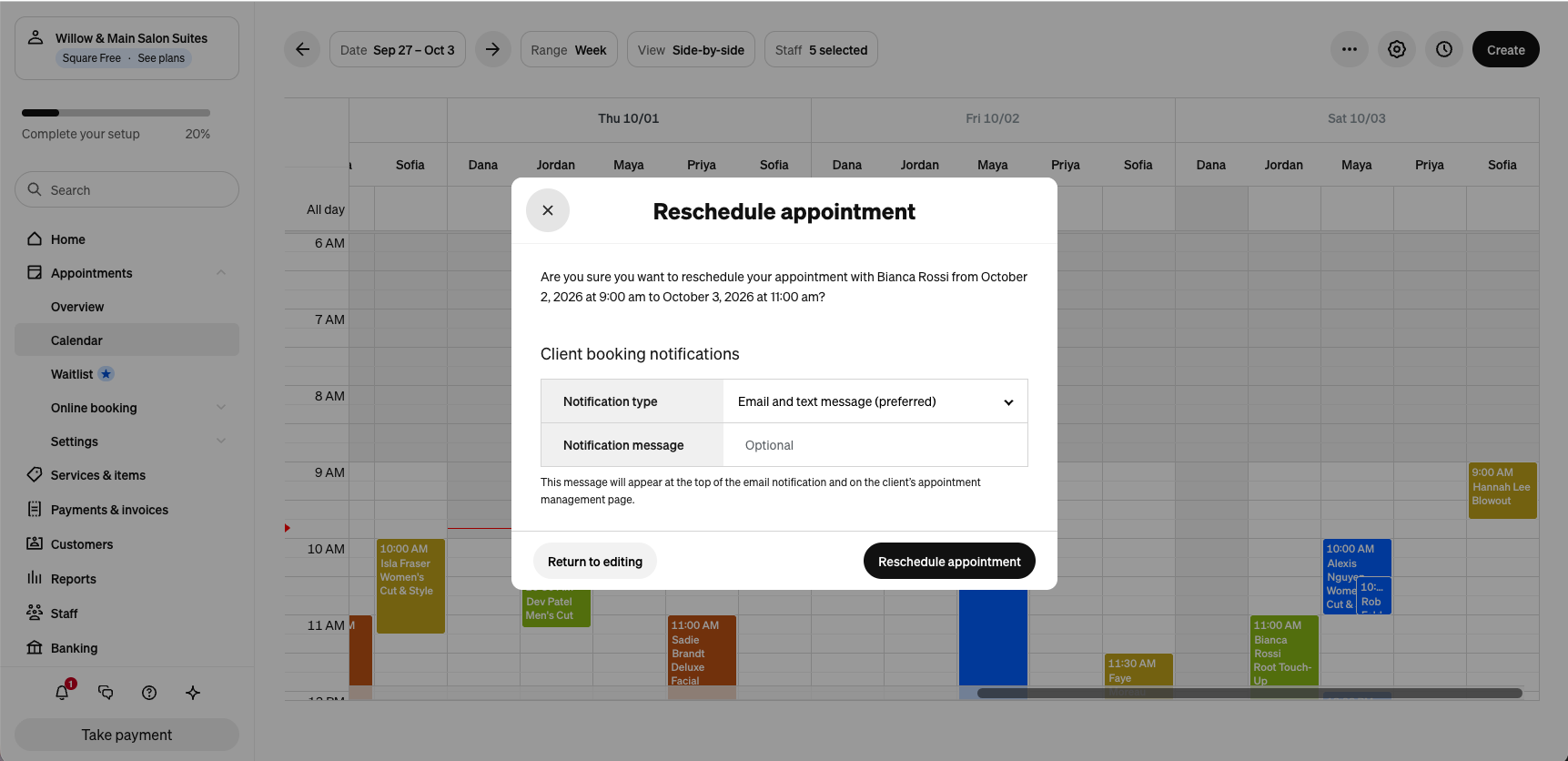
Square scored zero here, and it is the one place it finished below the whole field. The desk dragged the appointment to Saturday, a dialog asked are you sure and how to notify the client, and the move went through with no fee, no warning and no mention of the window. The moved appointment then carried no trace of ever having been elsewhere: the same booked by line, the same $95, nothing in the record. A desk reviewing Saturday cannot tell this was a late move, because Square Free has no window to measure it against.
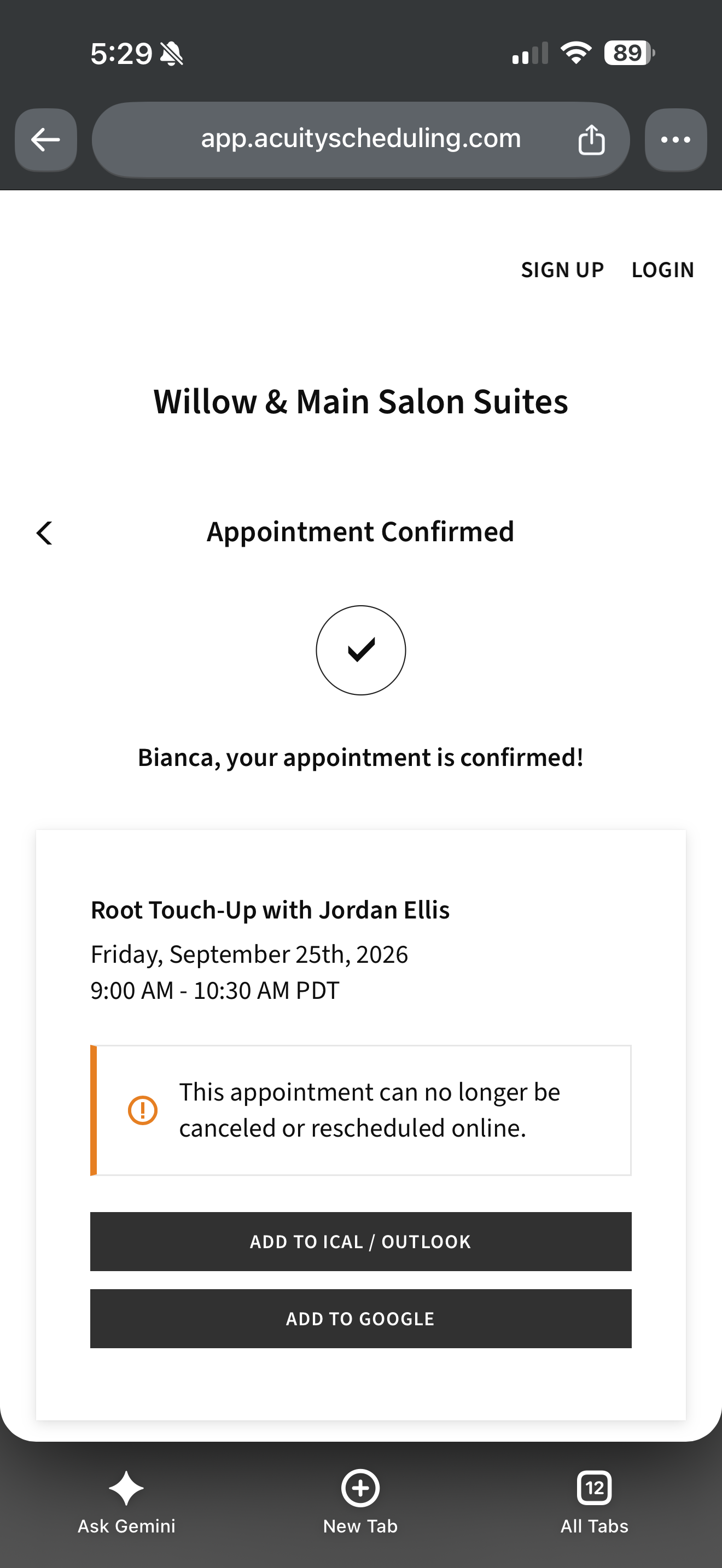
Acuity scored one, in the shape GlossGenius and Fresha did. The client side is a hard block: this appointment can no longer be canceled or rescheduled online, with no reason, no fee and no number to call. She learns she cannot; not why, or what to do next. The desk side then moves it free, with no warning and no flag, and the 25% appears nowhere.
The cancelled deposit. Cancelling a $140 colour two days out should refund or credit the deposit. Neither tool took one, so both were scored on the cancel itself and both scored one. Square’s dialog was the clearer: the record tags the appointment Seller canceled in red with no checkbox to find it behind. Acuity’s hides it behind the same unticked box as the no-show.
The double booking. A walk-in into an occupied chair. Both tools’ time pickers withhold the taken slot, which is good steering. Forced, Square shows an orange conflicts with events on Maya Brooks’s calendar banner and then saves on a plain click, with no override, and the calendar draws the overlap nested in the same colour with no marker. Acuity demands an explicit Yes, Reschedule Appointment and then stamps the day with a persistent successfully scheduled because you are an administrator banner. Acuity’s is the better block, and it scored two to Square’s one.
The discount and the gift card. A $90 facial, 15% off, then a $50 gift card: $26.50 due, card balance zero. Square computed the discount exactly and labelled it, and then hit the wall that defines the Free plan.
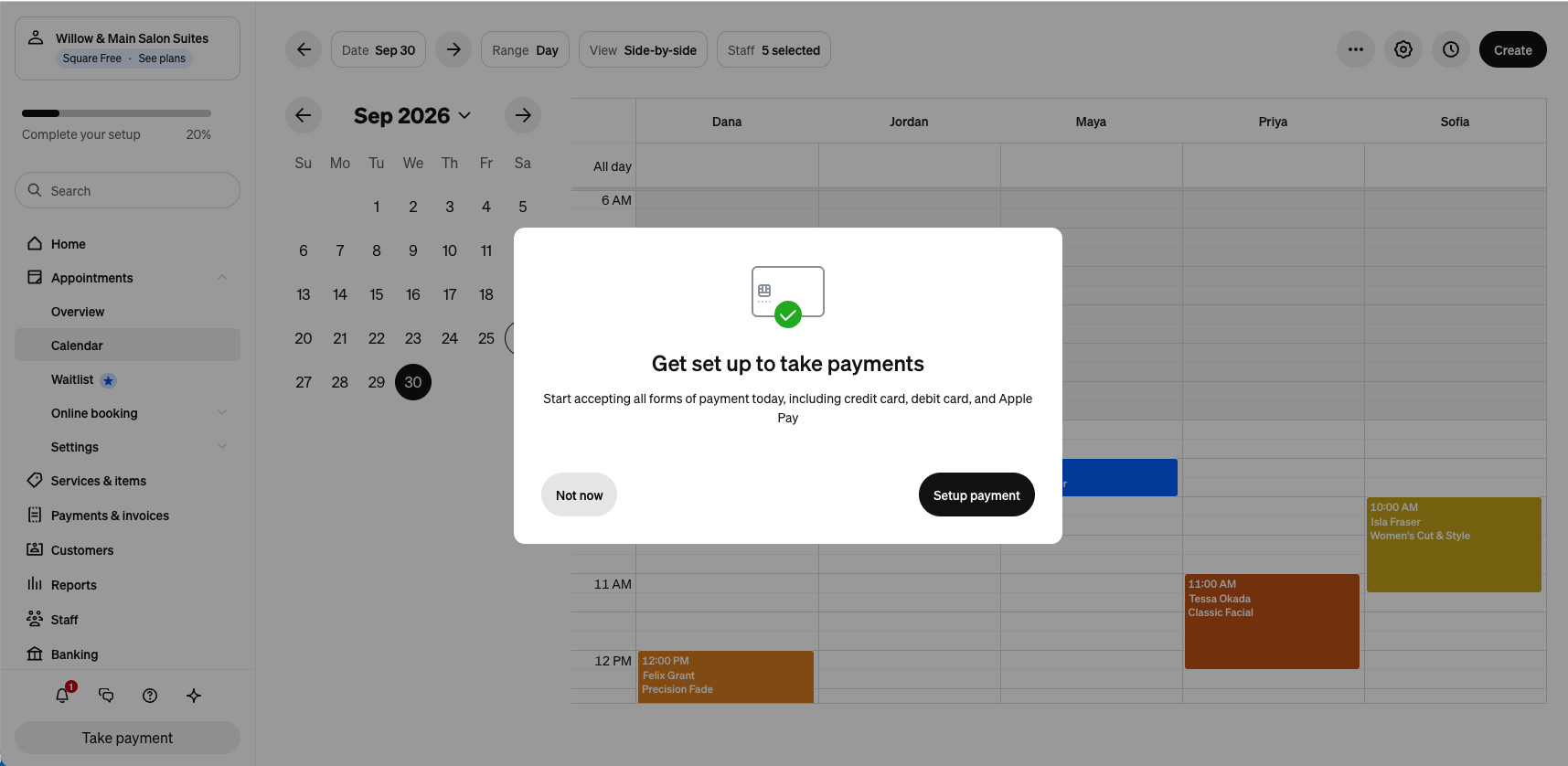
Square Free cannot record a payment. Not a card, not a gift card, not cash. Every other tool we have tested let the desk take cash with no processor; Square’s checkout is the processor. A free-plan salon can book a client, cut their hair and never mark them paid, which is also why every client’s last visited read never after a full scripted week. Square counts a visit when something is paid, and nothing can be.
Acuity’s problem was arithmetic, or rather a form field.
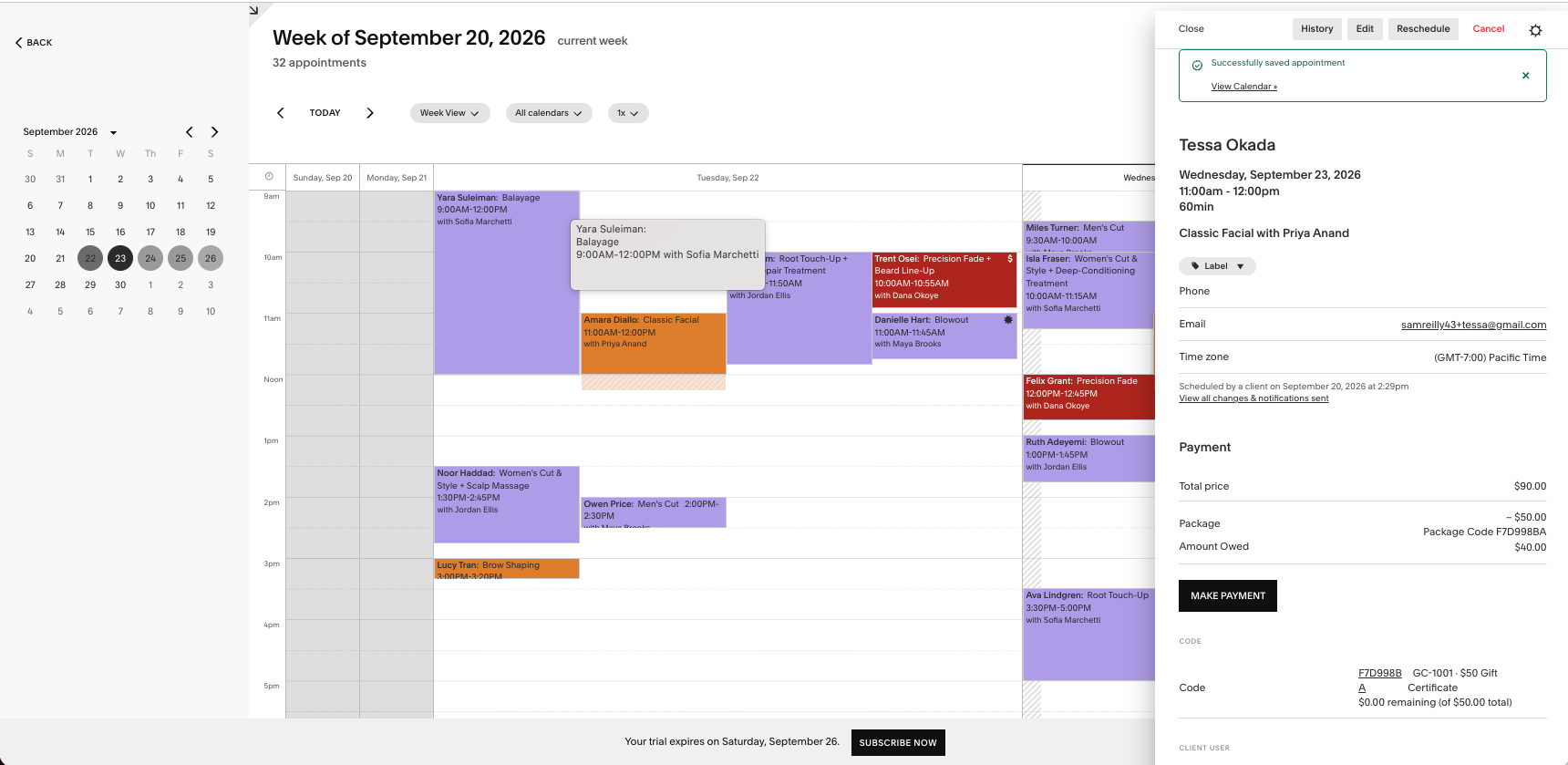
The appointment has one Code field, and it takes one code. Entering the gift certificate replaced the coupon with no warning, while the field showed a red used the max number of times error that was false, and the save went through anyway: $40 owed instead of $26.50. The desk can fix it by typing the price in by hand, which we did, and the discount then leaves no record on the appointment, the export or the receipt. The client’s own booking had computed the same pair exactly, so Acuity’s arithmetic is fine; its desk cannot hold a discount and a gift card at once.
The duplicate client. Two records for one Doyle, the second created by her own online booking. Neither tool flagged the pair. Square has a merge, and Square chooses the survivor: the record that booked was folded into the one that did not, and her email, first name and reference ID were not transferred, kept only as a note on the surviving record. Her upcoming appointment’s messages would now go to an address we made up. Acuity has no merge button at all. Its help centre explains that editing one profile’s name to match the other merges them automatically, and it does: both notes kept, the booking kept, the chosen record’s contact details kept, the other’s gone without trace. The desk picks the survivor, which is what the owner of a salon wants. But the merge is undiscoverable without the help centre, and it is silent on a name edit, which implies that correcting one client’s name to match another’s would merge two different people without a word. We did not test that implication, and we would not want to be the salon that found out.
The desk
Square’s calendar opens on a view called Combined.
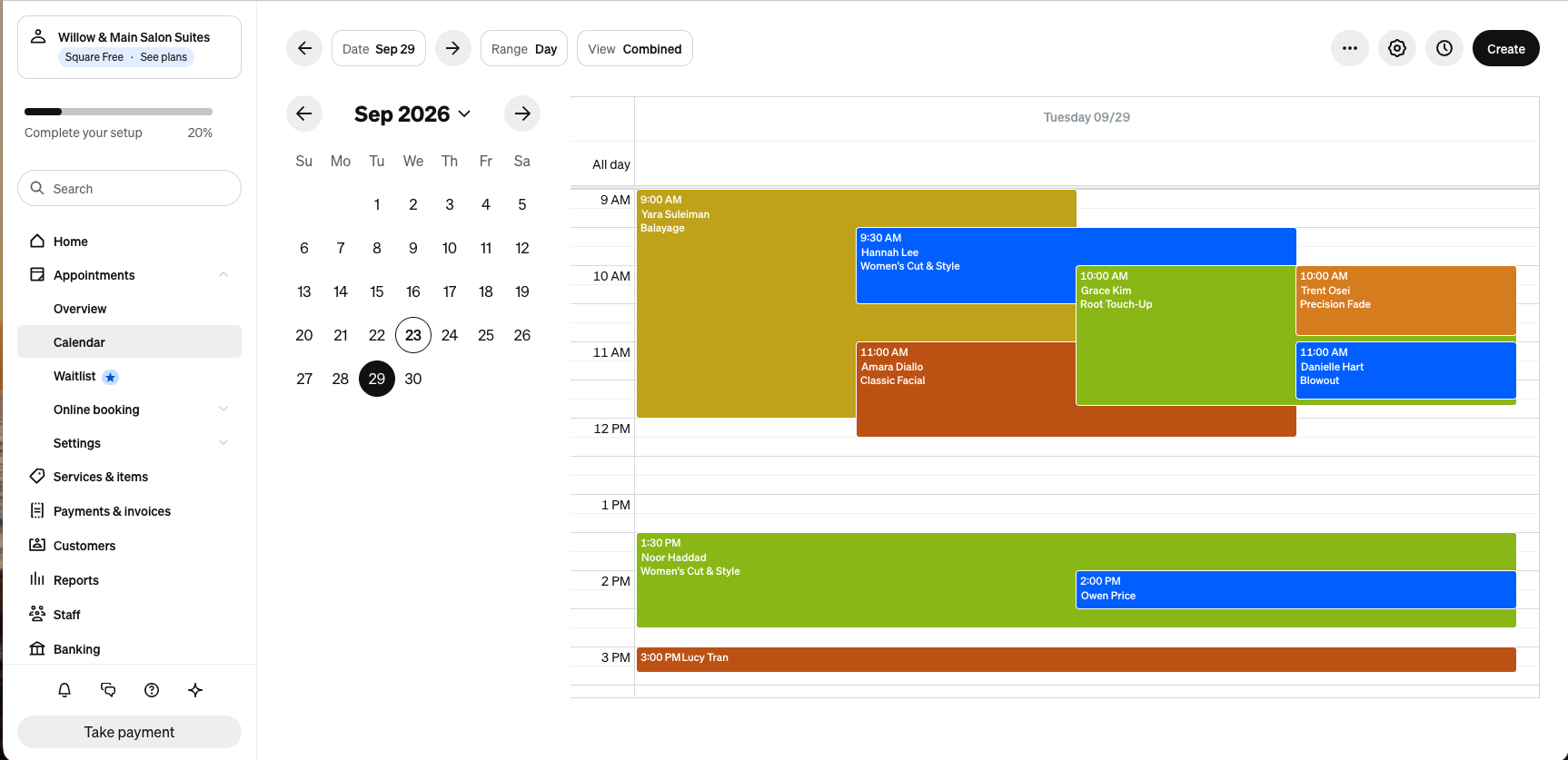
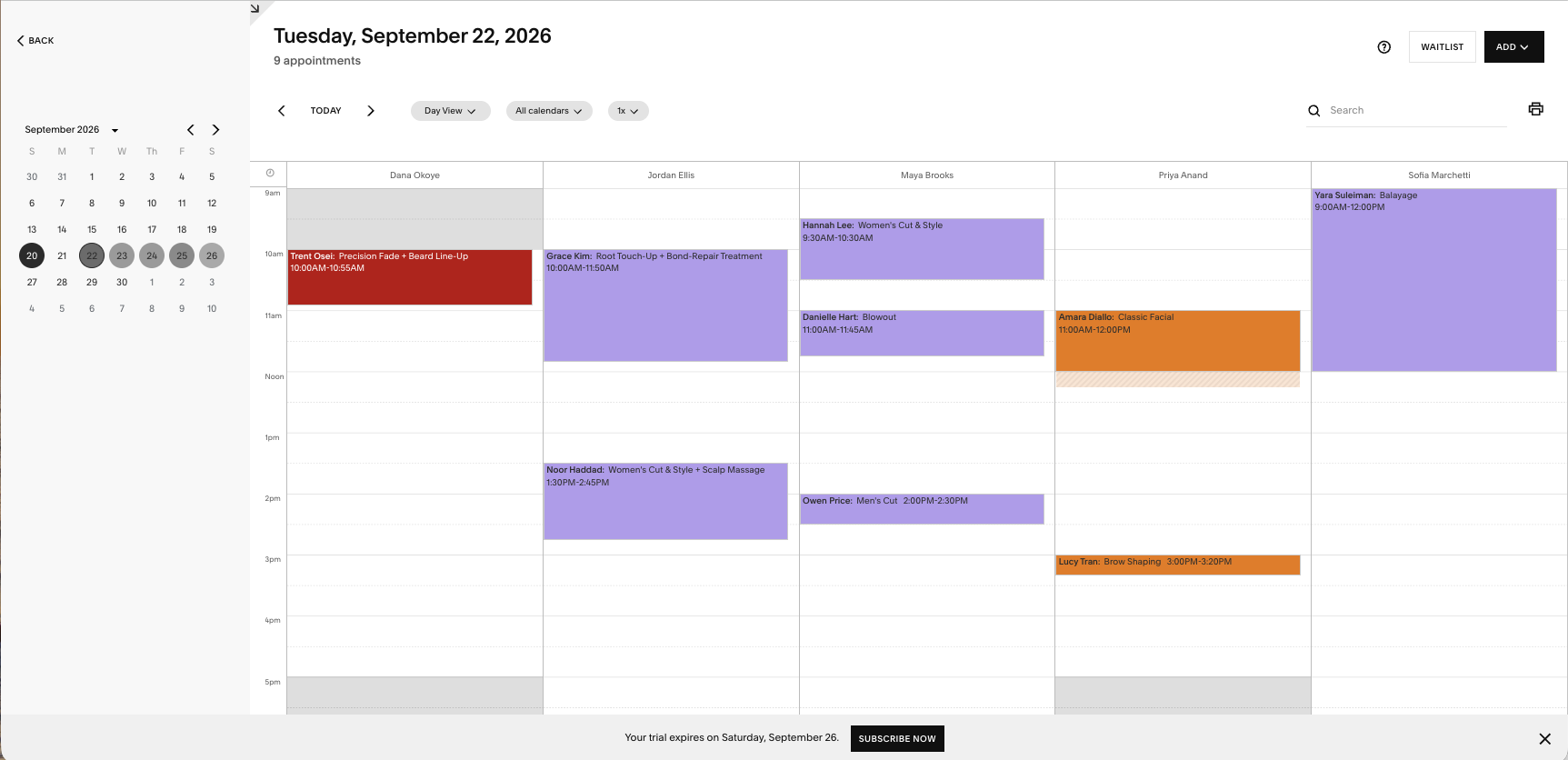
Combined stacks every provider’s appointments in one column with no provider name on any block, which for a five-chair desk is unreadable. Switching to side-by-side and filtering the staff fixes it, and the result is clean, though Owner, a record Square would not let us rename, is ticked by default and takes an empty column until you untick it. Acuity’s day view is right by default: a named column per provider, off-days greyed, the facial’s 15-minute turnover drawn hatched after the block.
Entry speed goes the other way. Our timed walk-in took 75 seconds on Square, most of it hunting a time picker that had hidden the slot we wanted, and about two minutes on Acuity, the slowest in the lab. Fresha did the same thing in ten seconds. And Acuity’s desk stopped taking appointments partway through loading the week.
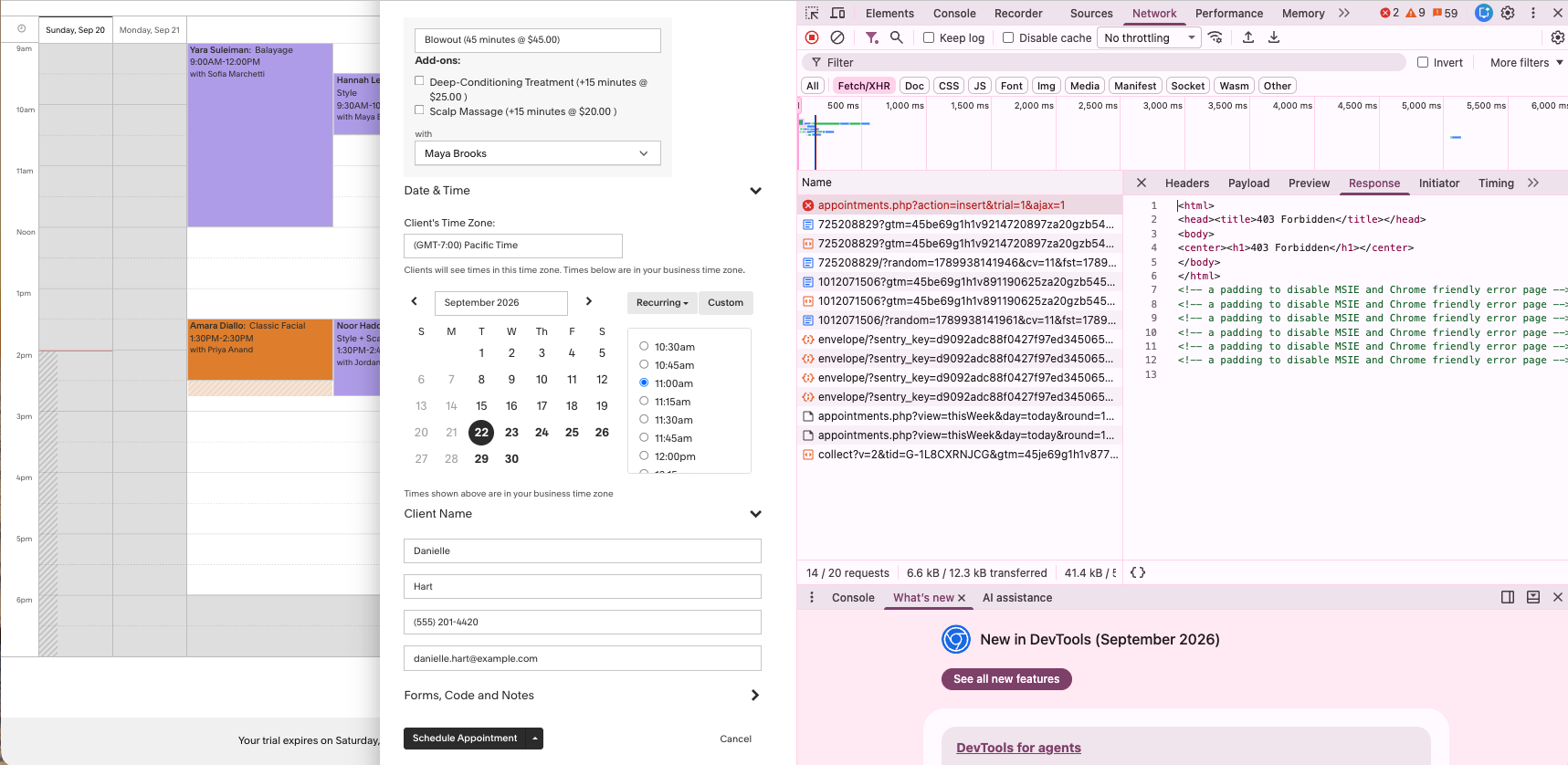
The public booking page was never affected; a client booked during one of the blocks. But the first thing any salon does with a new tool is load its existing book, and Acuity’s admin side refused ours after seven rows, with a generic error and no explanation, repeatedly. We loaded 33 appointments in short bursts around it.
Where Acuity’s desk is good, it is the best we have seen. The booth renter got a login scoped to her own calendar with one switch, and the switch beside it is the one that matters.
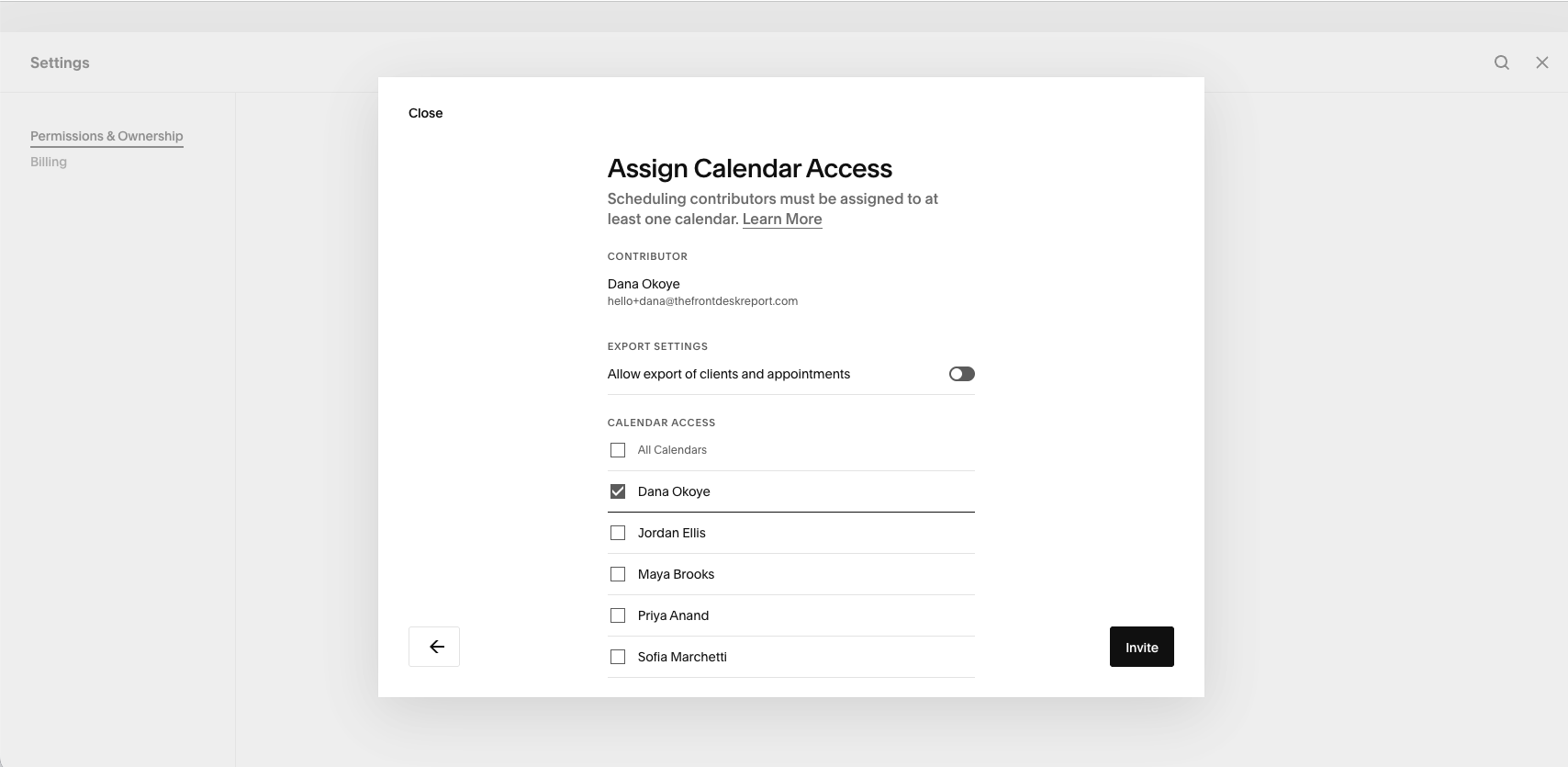
Square’s booth renter could be restricted to her own calendar too, but one permission set is shared by every team member on Free, so she could not differ from the employed stylists without Plus. Acuity’s intake form asked our esthetician’s questions inside the client’s booking and filed the answers, dated, on her record; Square’s Free plan cannot ask a client a question at all, since every answerable field is a paid feature. Acuity imported our client notes and showed them on the appointment. Square’s add-on model, on the other hand, is the best of five: a reusable set with its own price and duration per add-on, applied to many services at once, optional by default.
The membership went badly for both, differently. Square’s subscription plans open on Free, but a Square plan is a recurring sale of one catalogue item, so our $79 two-blowout club with rollover became a $45 blowout billed monthly with no credit count, no rollover and a name the client never sees, and selling it to anyone raised the identity wall. Acuity’s club was not for sale without a processor, but the desk could add a subscriber by hand, and that unpaid, inactive subscription then redeemed a blowout: count two to one, paid $0, a client record reading valid beside a subscriber list reading inactive. The blowout then appeared in neither revenue nor receivables. A membership nobody paid for, honoured, and invisible to the books.
Reminders, and who gets told
Both tools lost points on reminders for reasons that were partly ours.
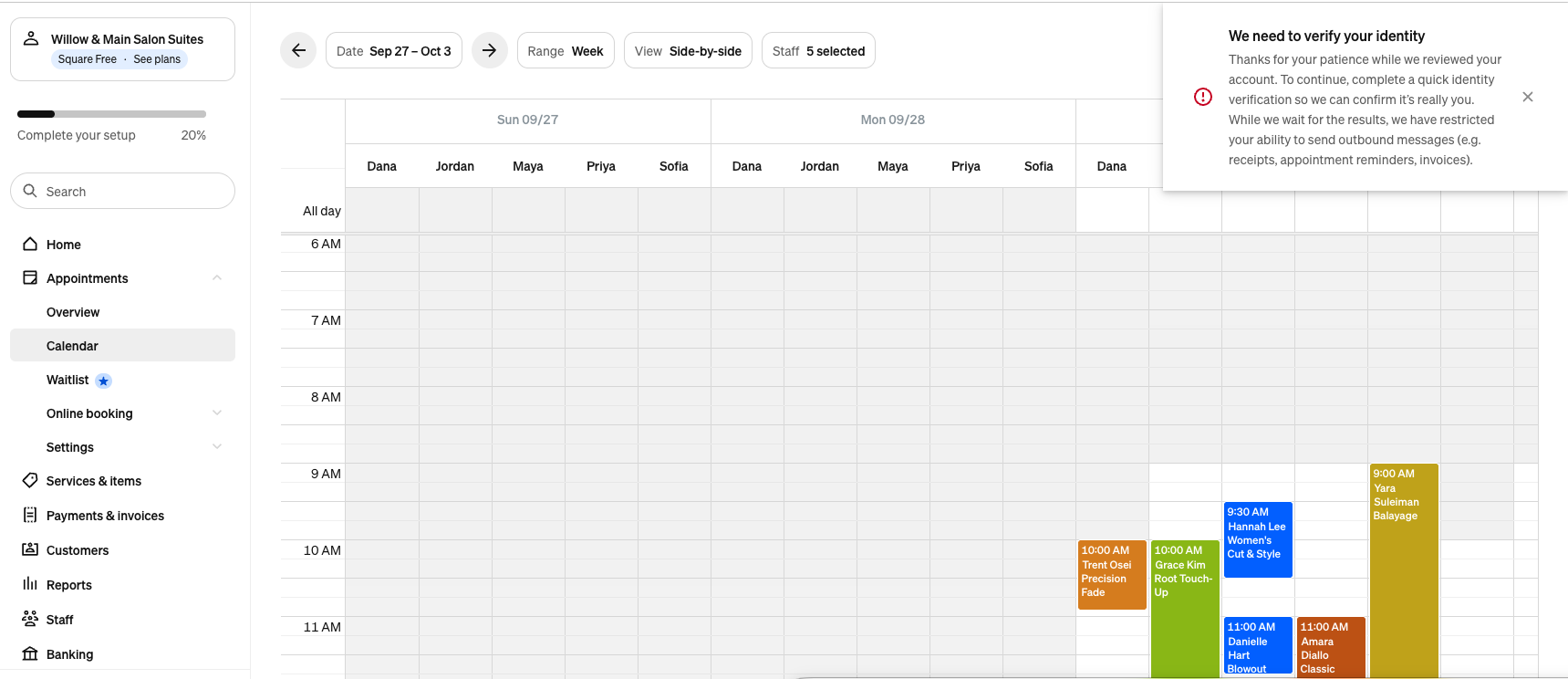
On the evening we loaded the week, Square sent about thirty booking confirmations to the addresses in our dataset, which are deliberately undeliverable. A burst of bounces from a new account is a textbook fraud signal, and we assume that is what tripped a risk review. A real salon with real client addresses may never see this screen. What a real salon can take from it is what Square does when the review fires: it cuts receipts, reminders and invoices, it says so once in a dashboard notice and an email, and the only way back is identity documents. We checked the two clients due the next morning’s reminders. Neither got one, and nothing on either record said so.
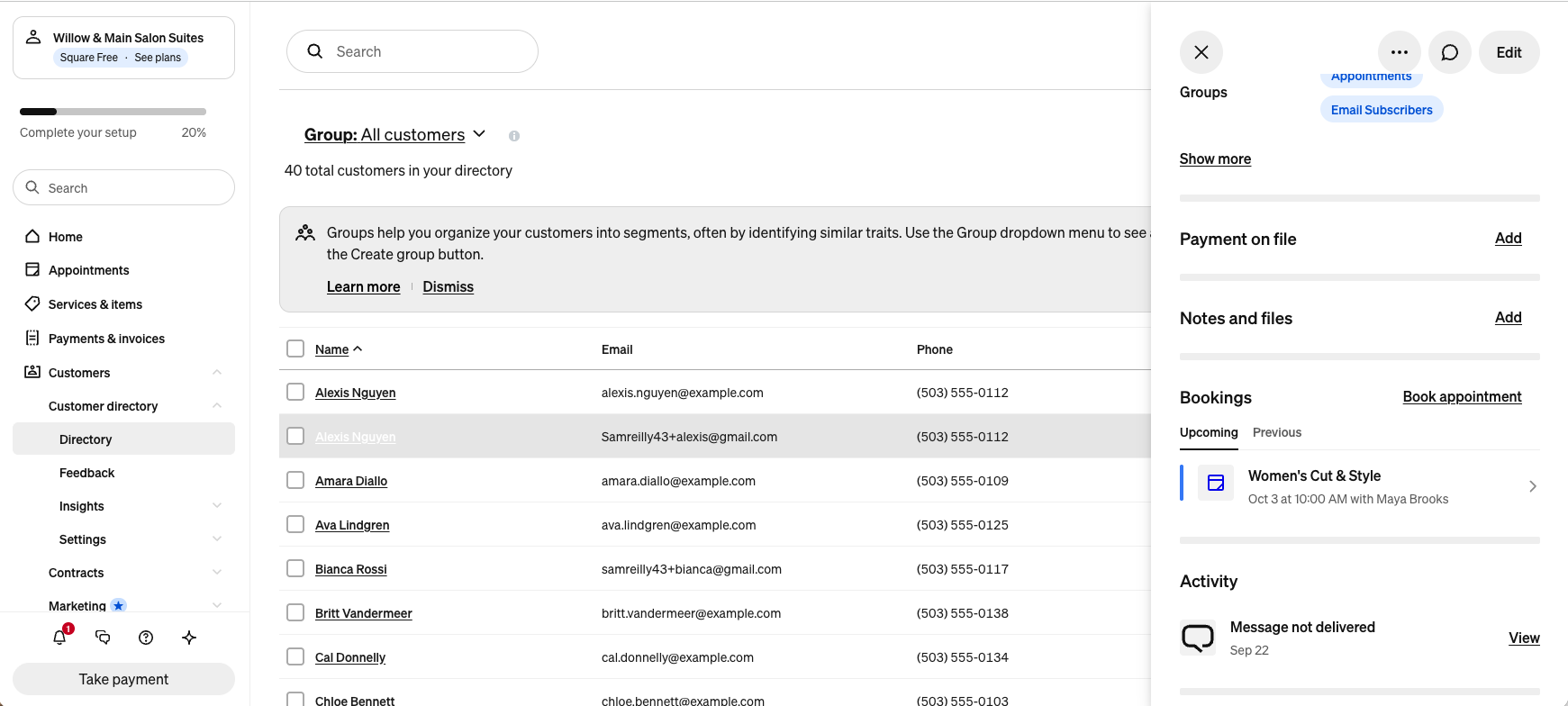
Square’s confirmations, before the freeze, were among the best we have seen: the same minute as booking, from the salon’s name, with a working reschedule link and the full policy text, and every desk change asks whether and how to tell the client. That earned it the point it kept.
Acuity’s confirmations were also good, and every one of them went to us.
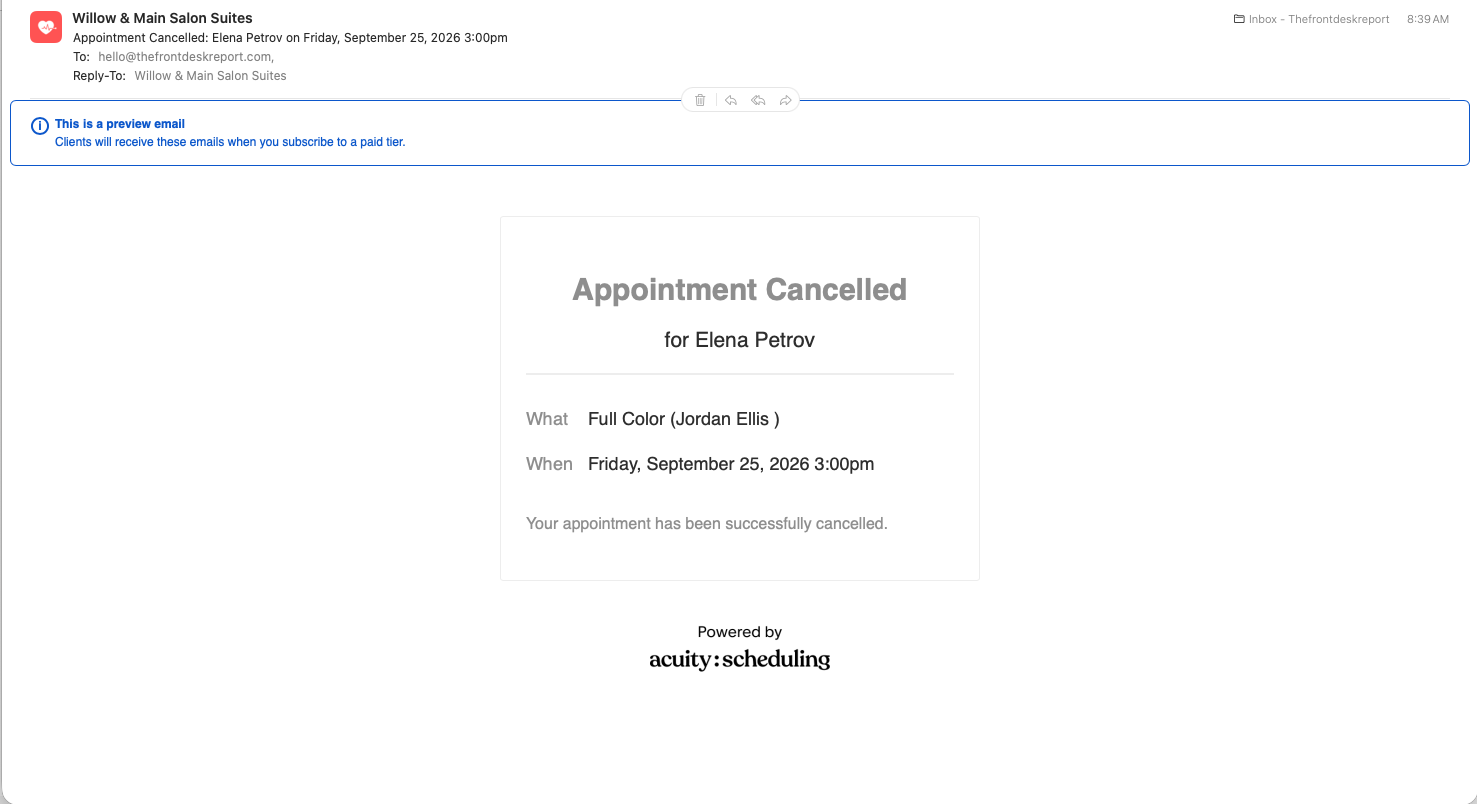
The trial sends no client any email. Confirmations, reminders, cancellations and receipts all arrived in the salon’s inbox as previews of what the client would have received on a paid plan, and the communications log named the client as the recipient anyway. The pricing page says 7 days, no credit card. It does not say your clients will not be told about their appointments. A salon that trialled Acuity on a real week would have clients booking, cancelling and being rescheduled with no notice at all, and the owner would find out from the banner. We scored it zero as experienced, and we note that on a paid plan the content of every one of those emails was fine, and the weekly summary that did reach us was accurate to the appointment.
A feature both tools ship
One screen in each tool belongs in a review of front-desk software even though it is not on our policy sheet.
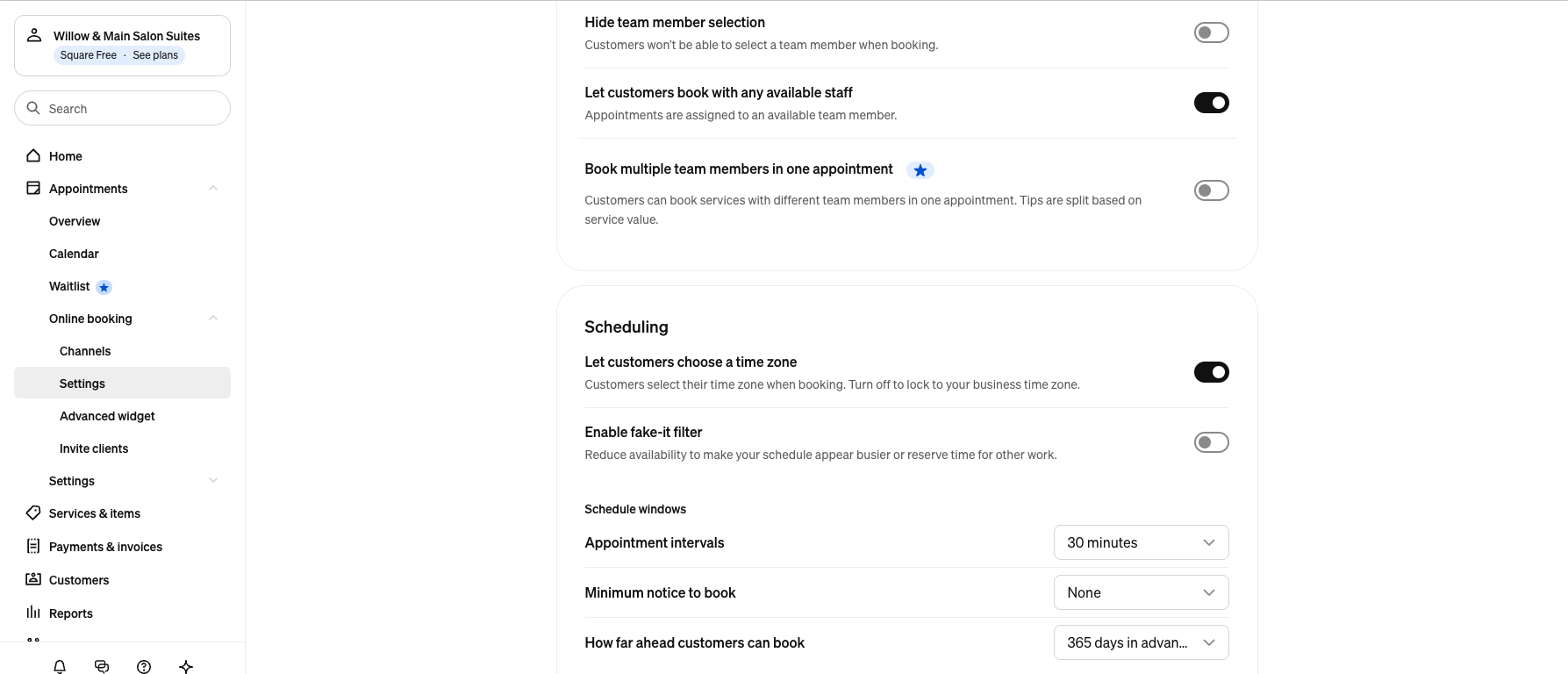
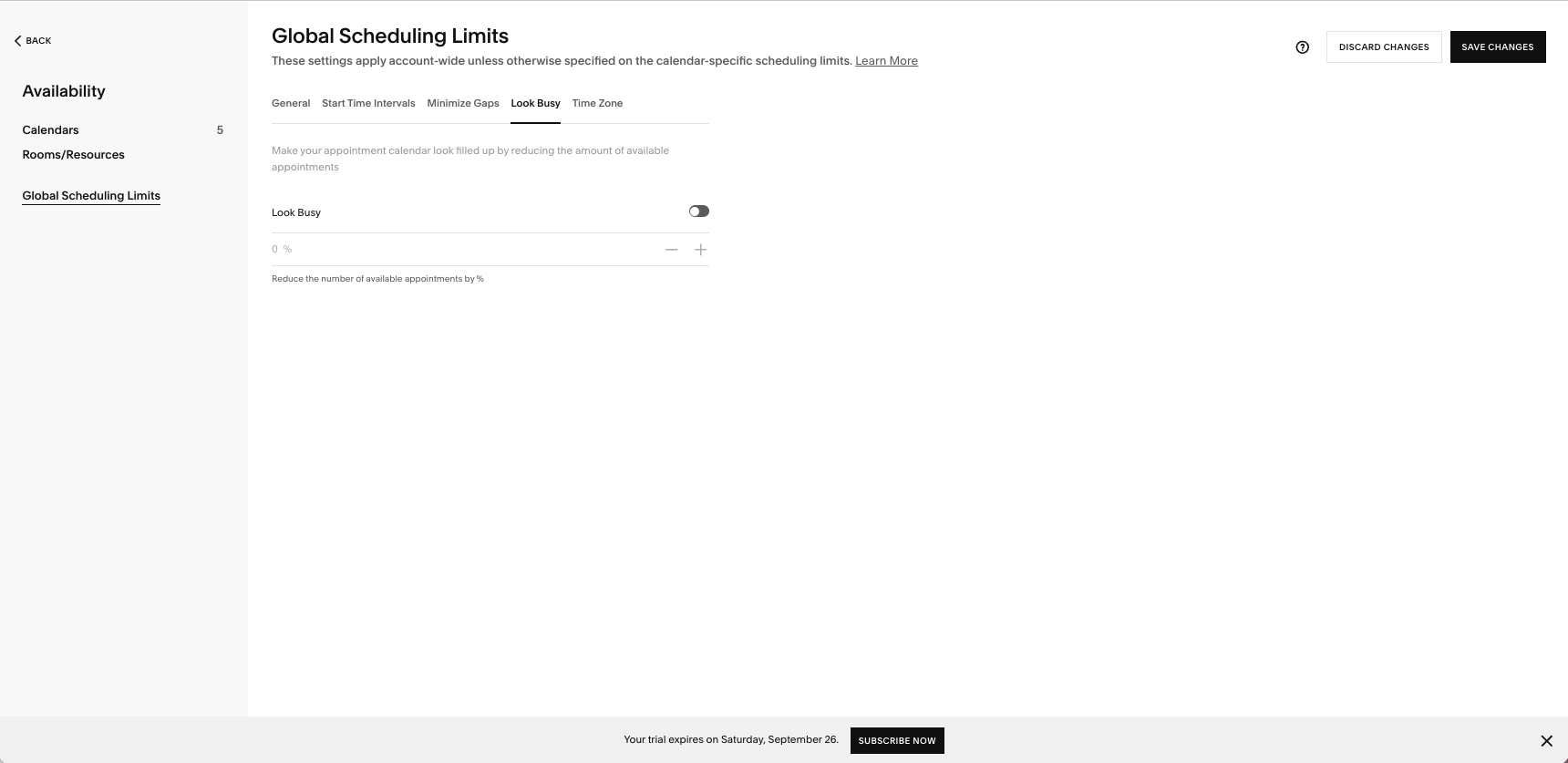
Square calls it the fake-it filter. Acuity calls it Look Busy. The second half of Square’s description, reserving time for other work, is a legitimate use; the first half, and all of Acuity’s, is a tool for showing clients a fuller book than exists. We are not scoring it. We are noting that two of five tools ship client-facing deception as a named setting, and that a client reading no availability this week on either booking page cannot know which kind it is.
Leaving
Both exits were honest, which after August and September is not nothing.
Square’s Free plan has no trial, so there was nothing to lapse. The thing that did lapse was a try Plus free countdown on the Home page, which read 71 hours on Monday, 50 on Tuesday, 4 on Thursday, and was gone that afternoon, replaced by nothing. It is the first deadline in five trials that meant what it said. What took its place was a setup panel describing our unstarted identity check as finish getting approved to accept payments: in progress, and a Plus card whose rotating pitch that day was pre-authorize cards, which is the exact capability the no-show policy needs and the exact thing Free cannot do.
We have not yet asked Square to delete the account. We will, once this piece is live, and we will report the turnaround here as we have for the others.
Acuity’s trial expired two hours after the expires today email, with an explicit modal, the dashboard still visible behind it, and the data visibly retained.
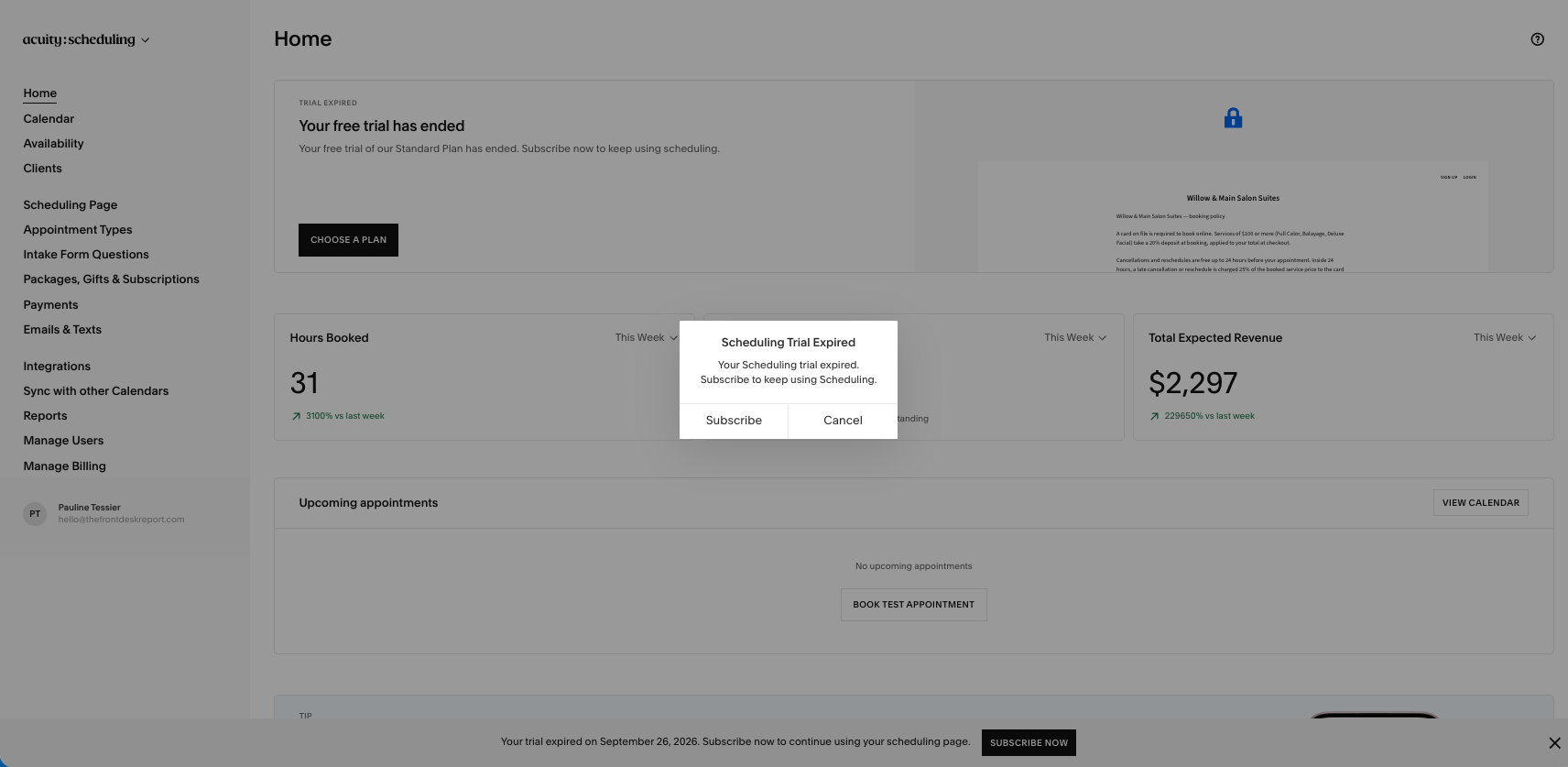
We filed a deletion request through Acuity’s support form that evening. The reply came in fourteen hours, from a person, accurate to our account down to the gift certificate we had bought for $0.
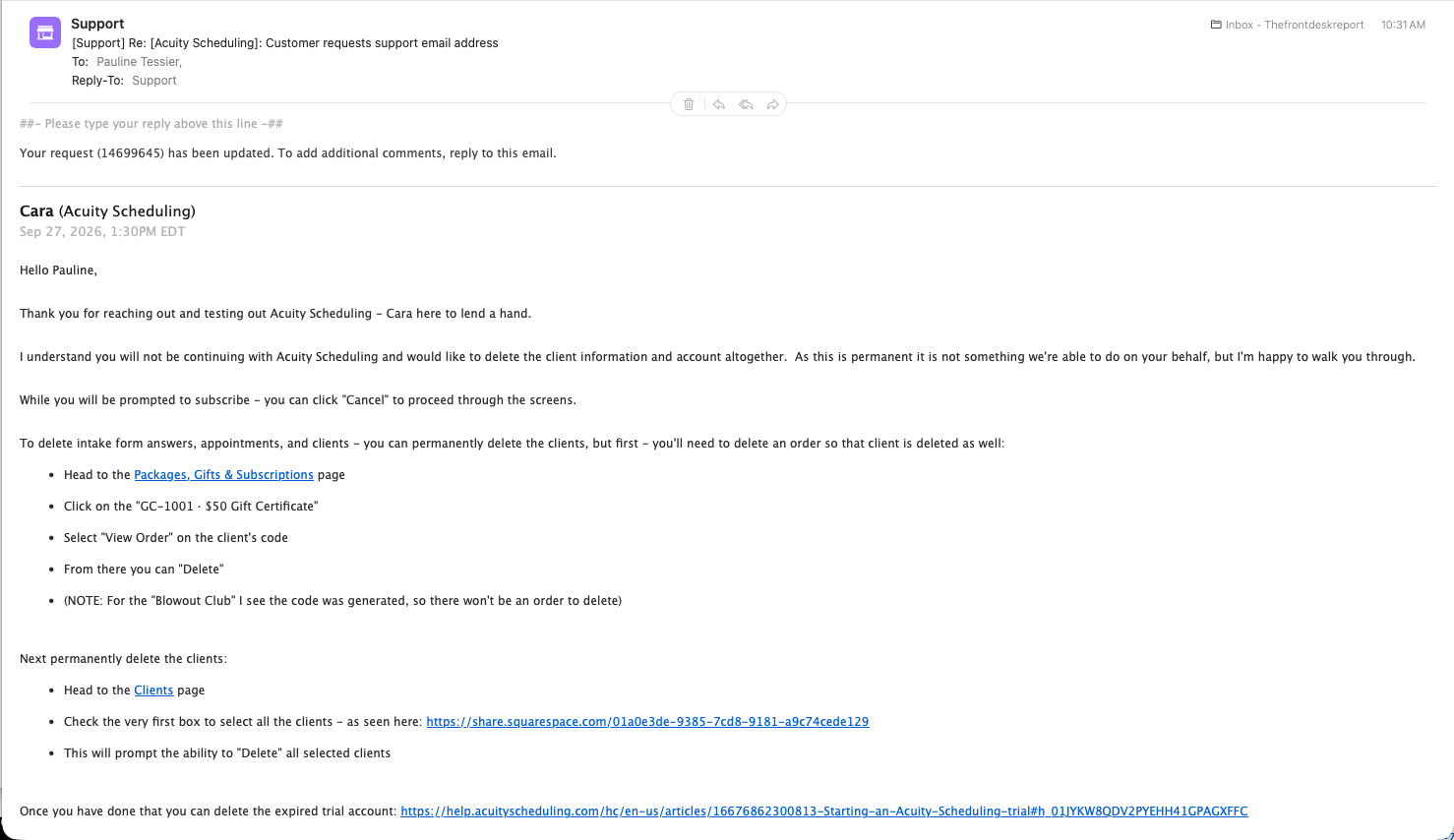
Acuity will not delete an account for you. It will tell you how, in order: delete the orders, delete the clients, delete the account. That is a worse answer than Fresha’s, which deleted everything in eleven minutes, and a far better one than Vagaro’s, whose self-serve path required a business account that was already closed, or GlossGenius’s, which never answered at all. We have not yet run the three steps, for the same reason we have not asked Square: a deleted account cannot be reshot. We will do both when this piece is published and report what survives.
Update, Oct 6, 2026: We did both the morning this piece went live, and the two exits took three minutes and fifteen minutes respectively. Neither was a deletion.
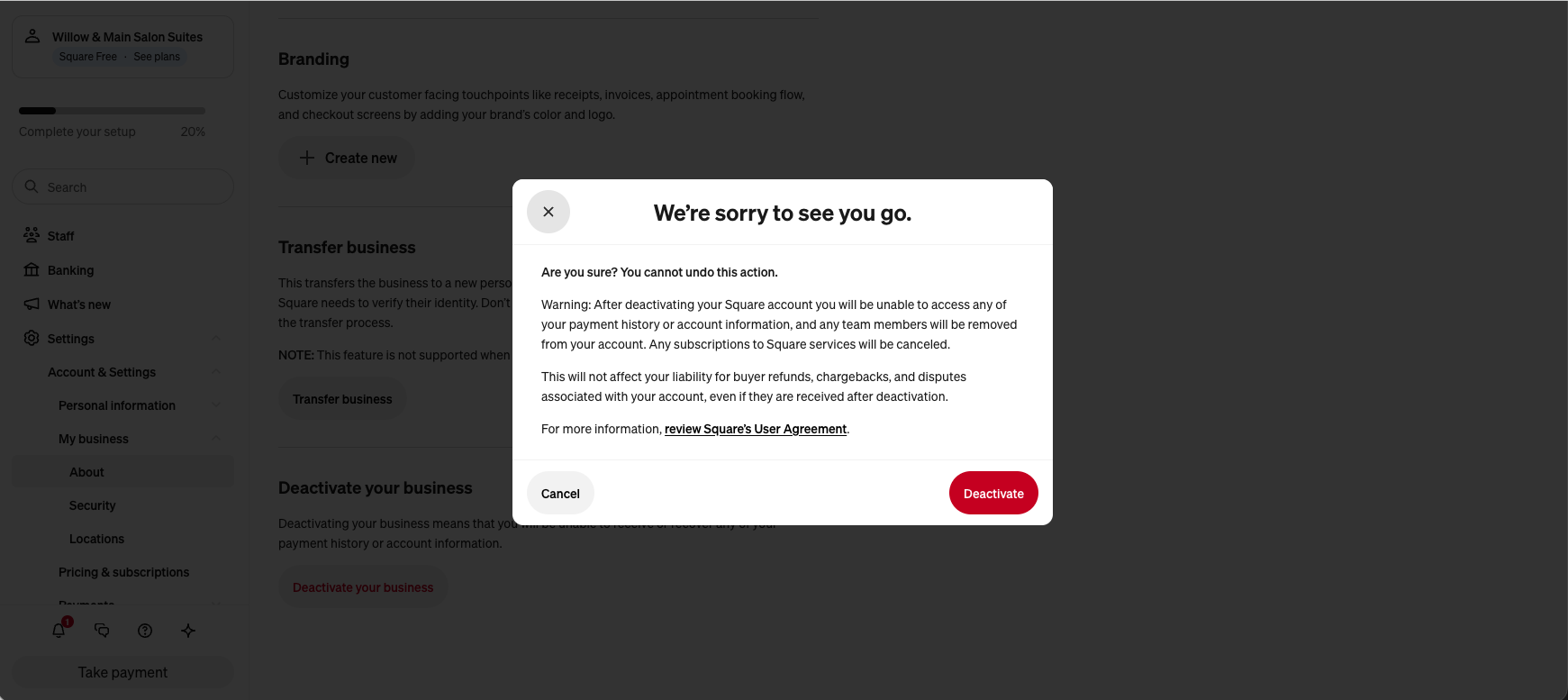
Square does not delete accounts. Its help centre says so, citing card-processing rules, and offers deactivation instead. The button is under the business’s About settings, and the path from it is the cleanest we have walked: a reason picker, where we chose other and typed the deletion request into the comment box so that it sits on Square’s own record; a warning; a second prompt from the authenticator app we set up on day one, which is the right kind of gate and not the identity check that froze our messaging; and a screen that says your account has been deactivated, thank you for using Square. Three minutes, no support contact, no password. Read the warning, though. It says we will be unable to access our payment history or account information, and that our liability for refunds, chargebacks and disputes survives deactivation. The word delete appears nowhere, and the email that arrived the same minute offered to reactivate the account at any time, easy and completely free. Forty client records, a scripted week and a no-show flag now sit in a closed account we cannot open, parked under a policy that does not offer deletion. The booking link, the one a client might have saved, now redirects to a Square login page: no 404, no this business has closed, nothing a client could act on.
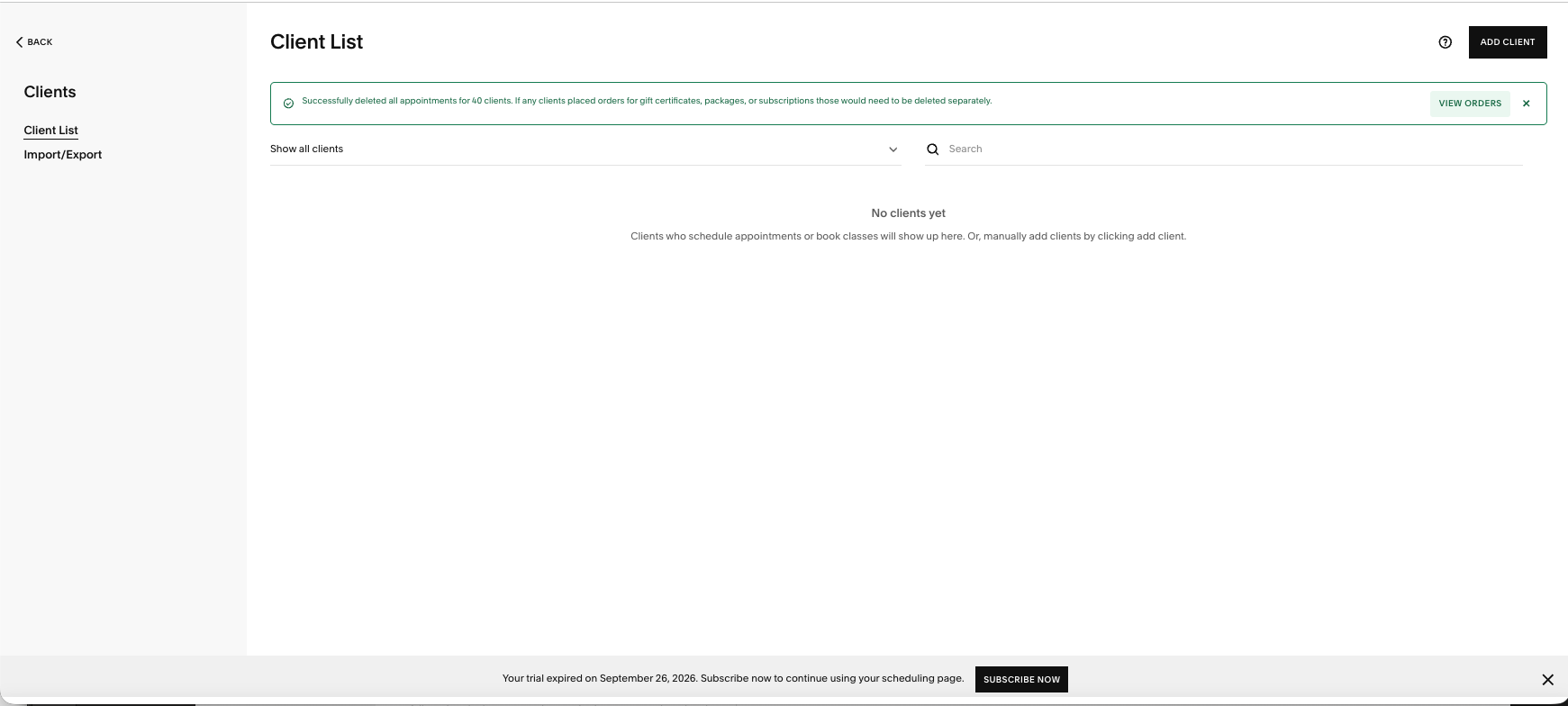
Acuity’s three steps went in the wrong order, because the first one is impossible. Step one, delete the gift certificate order, needs the orders page, and on an expired trial the orders page never loads; the request behind it returns a 403, insufficient access level. The account support wrote those instructions for cannot open its own orders. Step two, delete all clients, worked, with an honest permanent and not reversible confirmation, and then closed with the banner above: appointments for forty clients gone, orders must be deleted separately, and a view orders button that leads to the same 403. Step three is not an Acuity screen at all. Our login was a Squarespace account, so the account was deleted from the Squarespace dashboard, from the three-dot menu on the auto-provisioned site, behind a dialog that says your content will be permanently deleted and does not mention scheduling, clients or a retention period, because it is the website builder’s dialog, not the scheduler’s. The booking page returned a 404 within the minute. The Squarespace account itself survives, empty, and the Acuity admin tab, refreshed afterwards, reported that we had been logged out after a period of inactivity. Nine days from the deletion request to a deletion we did ourselves, and no confirmation of it has arrived. Whether the undeletable order went with the site, nothing says.
The six exits, for the record. Fresha deleted the account in three days and eleven hours, by a person, and then marketed to it anyway. Acuity would not delete but told us how, and one of its three steps does not work. Square deactivated in three minutes and keeps everything. Vagaro’s self-serve deletion needs a business account that is already closed, and when its support finally answered, 24 days after we asked, the answer was that the business is archived after 90 days, the customer profile cannot be deleted because it shares our email, and the phone number stays. GlossGenius never answered. We said at the top that both of these exits were honest, and we stand by it; honest is still not the same as gone.
The full scorecards
Scores are 0–2 per item: fails, works with friction, works well. The full item-by-item evidence, every screenshot, timing and settings screen behind these numbers, lives in our published score files, and the dataset both tools were tested against is downloadable.
| Square | Acuity | |
|---|---|---|
| Mobile booking flow | 2 — 2:30; silent Square account; phone required | 2 — ~2 min; guest booking; phone optional |
| Booking page truth | 2 — accurate; best policy timeline; no promo field | 2 — accurate; add-ons, coupon field, provider scoping |
| Card + deposit at booking | 0 — "require card" shows On, collects nothing | 0 — per-type 20% expressible, unsaveable |
| Confirmations + reminders | 1 — lab-best confirmations; reminders frozen, silently | 0 — trial emails no client; previews to the salon |
| TOTAL | 5 | 4 |
| Square | Acuity | |
|---|---|---|
| T1 double booking | 1 — banner, then saves on a plain click | 2 — explicit Yes + admin banner |
| T2 no-show fee | 0 — logged, removed, nothing charged | 0 — checkbox in the cancel dialog; nothing charged |
| T3 canceled deposit | 1 — no deposit existed; clear "Seller canceled" tag | 1 — no deposit existed; hidden behind a checkbox |
| T4 discount + gift card | 1 — discount exact; no checkout at all on Free | 1 — one code field; gift card replaced the coupon |
| T5 late reschedule | 0 — silent free move, no trace | 1 — client hard-blocked, no reason; desk moves free |
| T6 duplicate merge | 1 — merge exists; Square picks the survivor | 2 — rename-to-merge; desk picks; undiscoverable |
| TOTAL | 4 | 7 |
| Square | Acuity | |
|---|---|---|
| Day view + entry speed | 1 — Combined view unreadable; 75 s; no checkout, even cash | 1 — readable by default; ~2 min; 403 throttle at 7 inserts |
| Setup fidelity | 1 — best add-on model; intake and per-member permissions are paid | 2 — add-ons, intake, booth-renter export switch all native |
| Membership lifecycle | 0 — one-item wrapper; sale raises the ID wall | 1 — unpaid code redeemed; invisible to revenue |
| Client records | 1 — notes free; no intake on Free; merge note | 2 — intake answers and imported notes on the record |
| TOTAL | 3 | 6 |
| Square | Acuity | |
|---|---|---|
| Pricing honesty | 1 — best page of five; silent review freezes messaging; no checkout | 1 — prices honest; trial exclusions learned at the padlock |
| Rates + fine print documented | 2 — six rates on one page; 3.5% card-on-file on every plan | 1 — no rate published; modelled on Stripe |
| TOTAL | 3 | 2 |
Square Appointments or Acuity: which should you buy?
If you are a solo stylist or a booth renter who wants a booking page clients finish in under three minutes, a bill of $0, and a pricing page you can trust, Square Appointments on Free, with one condition. Know that it is a book and nothing more. It cannot take a deposit, charge a no-show, hold a card or record cash, and the day Square decides to review your account it will stop reminding your clients and will not tell you. If you take payments through Square’s reader, which most Square salons do, the wall is already behind you and the Plus plan’s policy tools are documented, not tested by us, at $49 a month.
If you want the desk that can describe your policy, scope a booth renter’s login properly, ask an esthetician’s intake questions and keep the answers, Acuity, with two conditions. Connect a processor on day one, because until you do, the policy you configure will not save and nothing in the product will tell you. And do not run the trial on a real week, because your clients will not be told anything about it.
If what you want is the policy sheet enforced, then after five tools and five trials we can say it plainly: on a trial, none of them does it, and a trial is the only thing a salon owner can test. Four tools scored seven out of twelve on enforcement. Square scored four. The difference between them is not that the other four enforce more; it is that Square’s free plan has nothing to enforce with. The next comparison we run is Boulevard against Mangomint, the two tools built for the salons that have outgrown all five of these, and the first two that will not let us in without a sales call. We will tell you what we could and could not test.
Filed under: square appointments · acuity scheduling · salon software · comparison · pricing